
Mobile Operating Systems Explained for Beginners
Introduction
The modern digital era can be defined by the importance of mobile phones in our lives. Mobile devices are used for various purposes like communicating, educating ourselves, having fun, purchasing things online, banking, interacting on social media, etc. No matter if we have to send messages, attend virtual classes, watch videos, or browse the web, cell phones make our work easier.
Most individuals make use of mobile phones on a daily basis, but for beginners, most of them do not really know how their devices operate effectively. They must be aware of the term “mobile operating system,” but they really do not know its meaning and significance.
The mobile operating system is among the most essential components of a smartphone. It controls the smartphone and makes it easy for users to use it. The operation of a smartphone cannot be possible without the mobile operating system as it would not be able to do anything.
Similar to how a computer needs an operating system to work, a smartphone too needs one in order to manage its hardware and applications. It works behind the scenes to make sure all parts of the phone work efficiently together.
The article below explains mobile operating systems in simple terms so that beginners can understand their role, significance, and importance in daily life.
What does “mobile operating system” refer to?
A mobile operating system refers to software that enables the operation of a mobile device and makes it possible for users to interact with it.
The mobile operating system can simply be defined as an intermediary between the users of mobile devices and mobile hardware. In other words, whenever the user presses the touchscreen, opens applications, uses the camera to take pictures or listens to music using the device, the mobile operating system enables the device to execute those commands.
The operating system controls everything from opening applications to controlling how the touchscreen responds to the commands given by the user and coordinating all the other processes and interactions of the mobile hardware components. Additionally, the mobile operating system coordinates the use of critical mobile device resources including memory, storage space, battery and overall mobile phone settings.
This means that the commands issued through the mobile operating system by the user such as adjusting volume and connecting to Wi-Fi networks are executed behind the scenes by the operating system itself.
Without a mobile OS, a smartphone could simply not work or function at all.
Why Do Mobile Devices Need an Operating System?
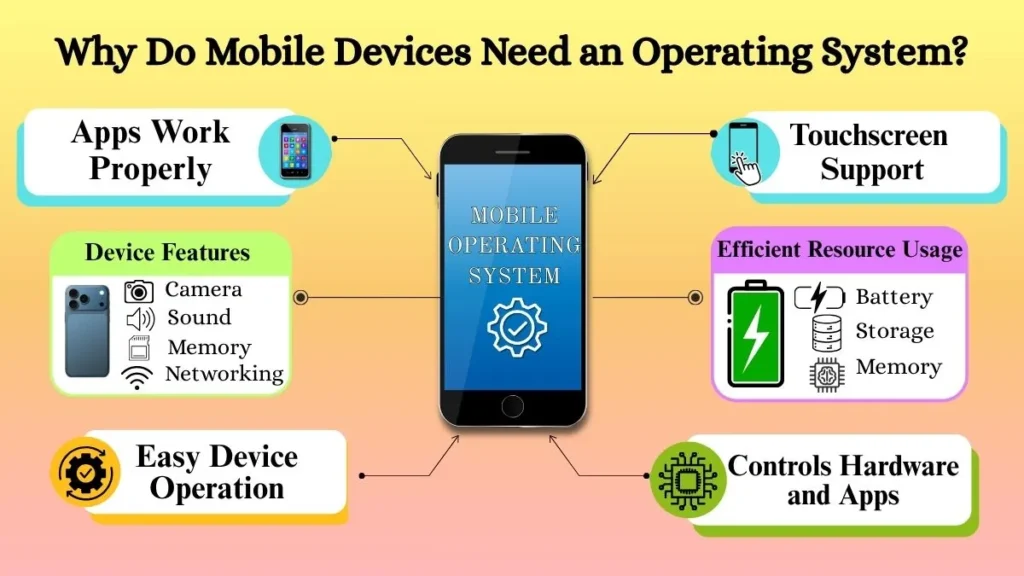
An operating system is necessary for mobile devices to function effectively.
Some main reasons for this include:
- It facilitates the proper operation of apps.
- It simplifies touchscreen inputs and outputs.
- It controls all features of the device like sound, camera, memory, and networking.
- It helps people operate with the device easily.
- It guarantees that system resources are used effectively.
It would be difficult to think about smartphones without the existence of the operating system. The touchscreen could not function correctly, the applications would not operate and the users would not be able to operate the devices in any way whatsoever.
Essentially, the operating system functions as a manager overseeing all activity on the smartphone. The applications, hardware and all user commands are controlled by the operating system.
This is the reason why the operating system is the most crucial part of the smartphone.
Common Types of Mobile Operating Systems
Over time, several mobile operating systems have been created. While some are utilized extensively, others are only utilized in specific settings.
Android (Basic Idea)
The Android operating system is considered to be among the most common mobile operating systems worldwide.
It is employed by many smartphone makers and is supported by a broad variety of smartphones. Because Android-powered phones are utilized by a wide range of organizations, they differ greatly in terms of size, style, and price.
Flexibility and availability are considered the main characteristics of Android OS. Android allows users to access various applications and services.
Due to its popularity and widespread use, Android phones are often preferred by beginners.
iOS (Basic Idea)
iOS is a mobile operating system which runs on Apple mobile devices.
It is an operating system which creates a well-controlled environment wherein users can use applications and device functionalities without much trouble. iOS is a type of OS that has been created to provide consistency in user experience.
There are many things about iOS that users like, including its simplicity and well-organized interface. Being created for only one brand of devices makes it consistent with other devices in that particular brand.
The most important lesson to be learned from this is that iOS is another well-liked mobile operating system.
Other Mobile Operating Systems (Brief Mention)
However, there are other mobile operating systems which have lesser popularity compared to Android and iOS.
These mobile operating systems may be designed specifically for a purpose or a type of device. Others had been highly popular in their own time, but today they are less popular than before.
It is sufficient for a beginner to know that the well-known mobile operating systems include Android and iOS, and apart from these there are other operating systems too.
Key Characteristics of Mobile Operating Systems
Mobile operating systems include various kinds of features that make using a smartphone easy and convenient.
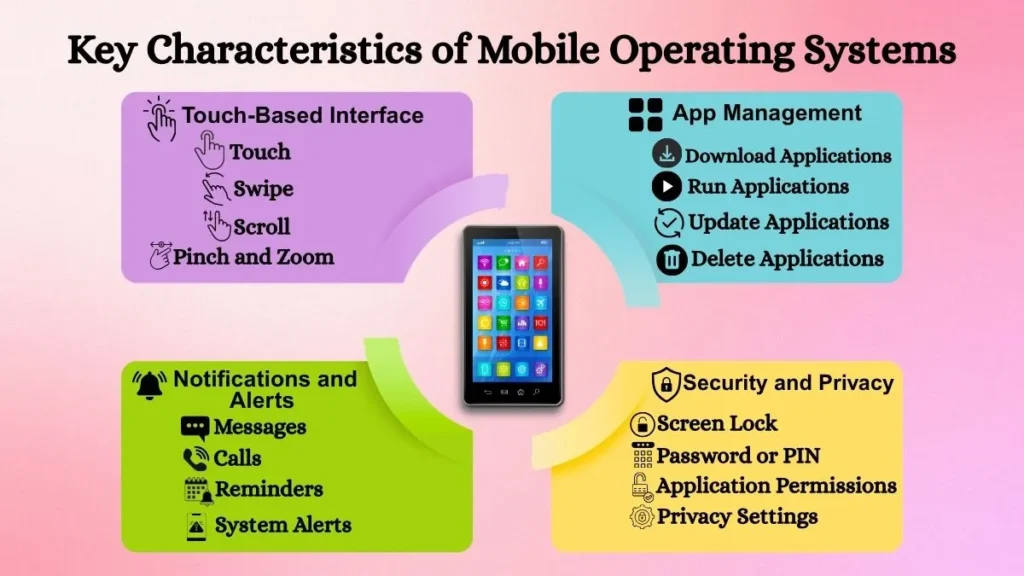
Touch-Based Interface
One of the most crucial characteristics of any mobile operating system would be its touch-based interface.
As opposed to computers where the major input/output methods involve a keyboard and mouse respectively, phones are created to be operated using touch.
Among others, it enables a user to control a phone by means of:
- Touch
- Swipe
- Scroll
- Simultaneously zoom and pinch
Because of this, users may flip between pages, slide between screens, and open applications by only clicking their icons.
Smartphones touch-based design makes them easy to use even for beginners.
App Management
Applications are very important in today’s smartphones.
An operating system allows one to download, execute, update, and delete applications. Applications enable users to conduct various tasks like chatting, studying, playing games, banking, and even browsing the internet.
The operating system controls how applications are executed and functions.
For instance, when many applications are being used, the operating system organizes system resources to allow for switching from one application to another.
An improved user experience is made possible by this management.
Notifications and Alerts
Notifications are provided by mobile operating systems to ensure the user is always kept up to date regarding any significant happenings.
The notifications may include the following:
- Messages received
- Calls
- Applications needing attention
- Reminders
- Alerts from the system
Through notifications, the user does not need to open each application separately to obtain necessary information.
For instance, if the user receives a message, a notification will pop up for a quick response.
This function helps consumers keep informed throughout the day and increases convenience.
Security and Privacy (Basic Idea)
Security is an essential element of mobile operating systems.
Modern phones store personal information, photos, files, and details of various accounts. Therefore, modern mobile operating systems have many elements designed for data protection.
Some of the elements are listed below:
- Screen locks
- Password or PIN
- Application permissions
- Privacy settings
Users can limit applications from accessing particular information and using other device features.
All these elements make using smartphones more convenient and safe for their owners.
Where Are Mobile Operating Systems Used?
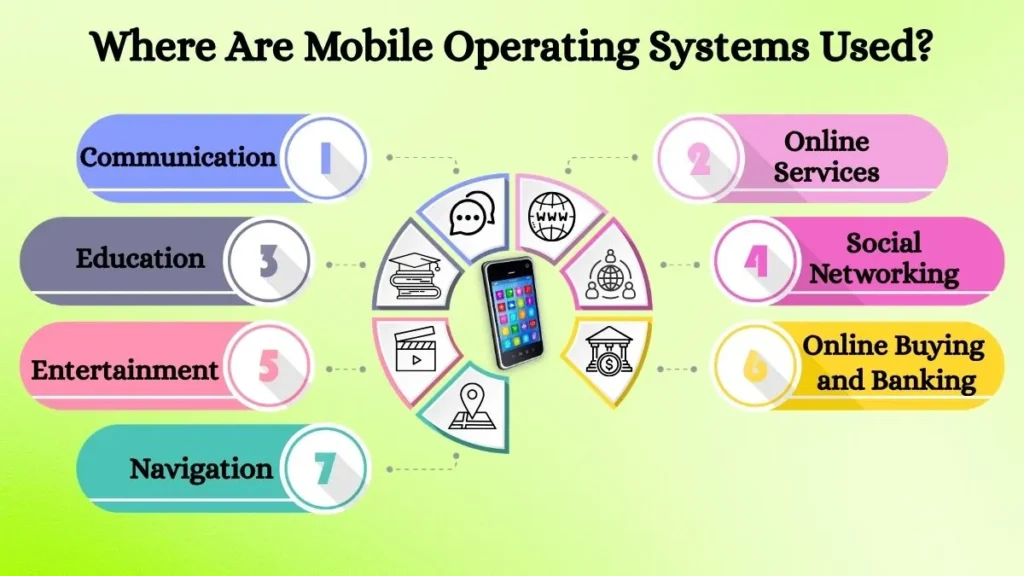
The mobile operating system is used in a variety of daily activities.
It allows various activities which are regularly performed using the smartphone.
Some examples of the usage of the mobile operating system are:
- Communication through voice or messages
- Using online services
- Education or learning
- Social networking
- Entertainment like watching movies or playing games
- Online buying and banking
- Navigating around places
For instance, a student might use the smartphone for education, whereas a professional might use it to communicate or work.
Due to the various uses of the mobile operating system, smartphones have turned out to be useful devices.
Advantages of Mobile Operating Systems
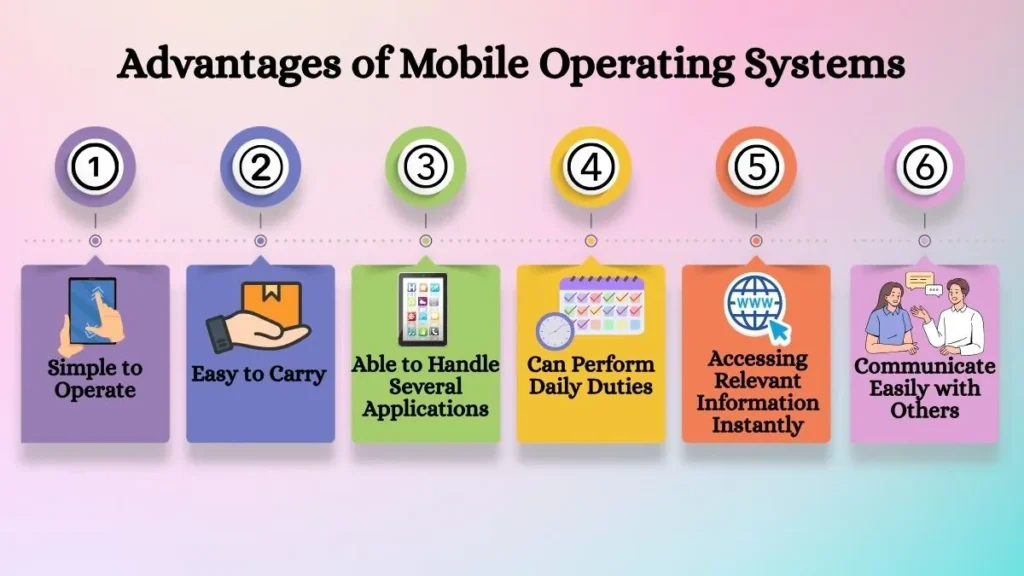
There are various advantages in having mobile operating systems that enable people to make use of their smartphones.
These advantages include the following:
- Simple to operate
- Easy to carry
- Able to handle several applications
- Can perform daily duties
- Accessing relevant information instantly
- Communicate easily with others
All of these contribute to efficient task completion wherever you are.
No matter what your intention is whether for learning, communicating, working, or enjoyment, mobile operating systems make it all possible.
Are Mobile Operating Systems Beginner-Friendly?
Absolutely, mobile operating systems are made easy enough for beginners to handle.
Modern mobile devices feature a user-friendly interface that makes learning how to use some basic functions on the device easier. Icons, menus, touchscreen capability, and other visual components help in navigating the mobile system easily.
A beginner can gain familiarity with various functions over time due to consistent use of his device. Actions like calling another person, texting someone, accessing apps, and browsing the Internet make users feel more confident while using a smartphone.
The user-friendly nature of today’s mobile operating systems helps individuals from all generations and skill levels use a smartphone conveniently.
Therefore, mobile operating systems can significantly contribute to adapting to the new technology.
Conclusion
Mobile operating systems have become crucial parts of the smartphones that we use today. These operating systems enable management of the device itself and its processes, as well as providing a smooth interface for interactions with the phone.
The operating system enables the running of applications, touch-screen operations, provides notification services, and also ensures safety measures for the user through the provision of basic security.
Several mobile operating systems exist, but some common ones are Android and iOS, among others. The purpose of mobile operating systems is basically to ensure that the smartphone becomes effective and easy to use.
It will help beginners understand computers and smartphones as technologies through the basic information provided about mobile operating systems.