
What Is Artificial Intelligence (AI)? Beginner-Friendly Guide
Introduction
You may have encountered artificial intelligence (AI) without even realizing it. When your phone unlocks after recognizing your face, YouTube recommends a video you might like, or a chatbot answers your question, some form of AI may be working behind the scenes.
AI is becoming a common part of the technology we use every day. It exists within smartphones, web applications, internet services, companies, healthcare, educational institutions, and more.
But what exactly is Artificial Intelligence?
In simple terms, Artificial Intelligence is a field of computer science that aims to enable machines to perform tasks that usually require human intelligence.
These tasks can include recognizing images, understanding language, finding patterns, solving problems, and making predictions.
What Is Artificial Intelligence?
Artificial Intelligence is a field of computer science that focuses on creating systems capable of performing certain tasks in an intelligent way.
For example, when you browse products on a shopping website and later see similar products recommended to you, the service may be using AI to analyze your activity and identify patterns. Similar concepts are applied in various other applications.
Programs that can recognize faces, identify spam emails, or answer questions are examples of systems that can perform tasks associated with human intelligence.
Typically, traditional programs are created to complete very specific tasks, programmed by developers. AI, on the other hand, can utilize specific data and patterns to come up with a solution.
How Does Artificial Intelligence Work?
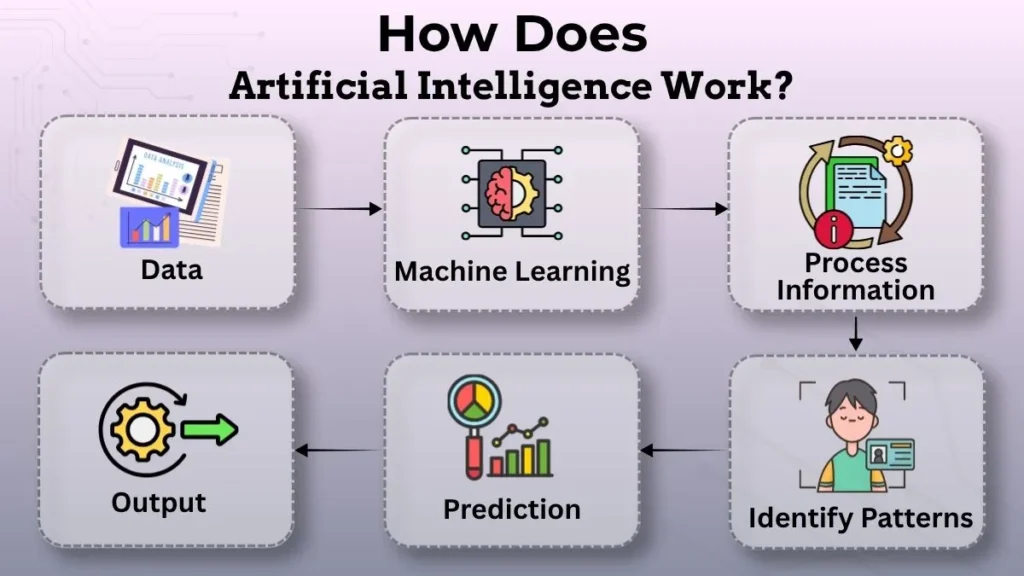
Various forms of artificial intelligence work by utilizing data, algorithms and computer models to process information. The system will analyze the data provided and attempt to use patterns within the information to produce some form of output.
An important technology which enables modern artificial intelligence systems is known as machine learning. With machine learning, a system can learn patterns from examples instead of requiring developers to manually program every possible situation. Developers can supply the algorithm with thousands of labeled images of various objects for it to learn patterns from. After the process is complete, the system will be able to observe new photos and predict what objects they might contain.
In practice, the algorithms used for such computer vision tasks are significantly more complex, but the principle remains the same; information is processed to allow a machine to complete tasks.
What Are the Different Types of AI?
AI is often divided into three broad categories based on its level of capability.
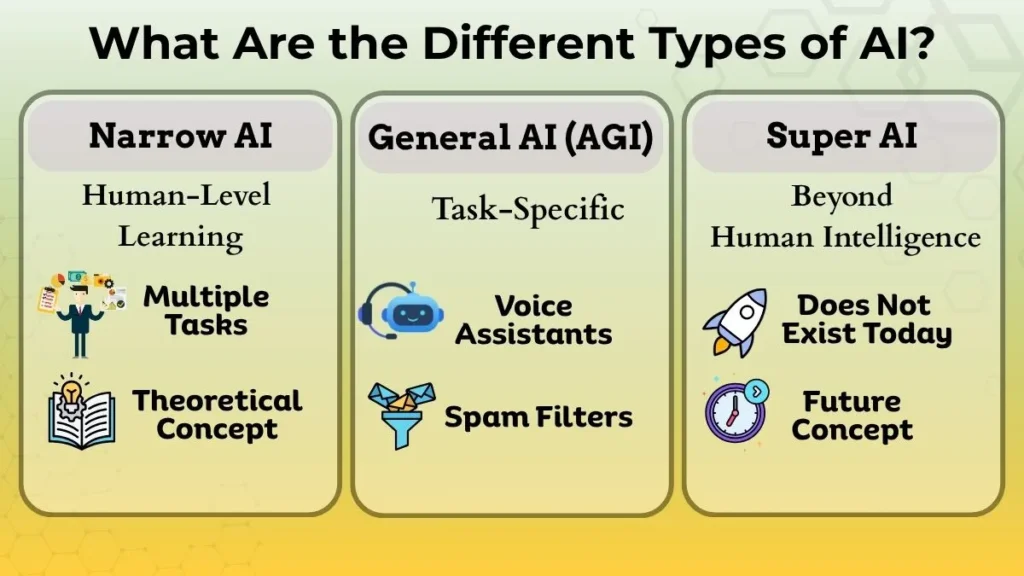
Narrow AI
Narrow artificial intelligence, also referred to as Weak AI, it is the type which is currently found in a wide variety of systems. Narrow AI systems are designed to perform a specific set of tasks.
For example, a GPS application can provide directions based on the traffic conditions of a specific area. Another common example is a spam filter function, which attempts to identify emails that should be moved to the spam category.
In other words, Narrow AI is designed for a limited purpose. It may perform its task very well, but it is not designed to handle every type of problem like a human can.
Common examples of Narrow AI:
- Voice assistants
- Recommendation systems
- Spam filters
- Facial recognition
- AI-based translators
- Navigation and route systems
General AI
Artificial General Intelligence, or AGI (Artificial General Intelligence), is a hypothetical type of intelligence which would allow a system to perform a broad range of intellectual tasks similar to a human being.
In contrast to narrow AI, systems which would possess general intelligence can learn and adapt to perform a variety of tasks. AGI remains a theoretical concept, and no existing AI system is generally recognized as true AGI.
Super AI
Artificial super intelligence is a hypothetical form of artificial intelligence that would greatly exceed human capabilities in all areas.
It is primarily a concept that comes from discussions about AI’s future potential and dangers, and does not exist today.
Where Can Artificial Intelligence Be Practically Used?
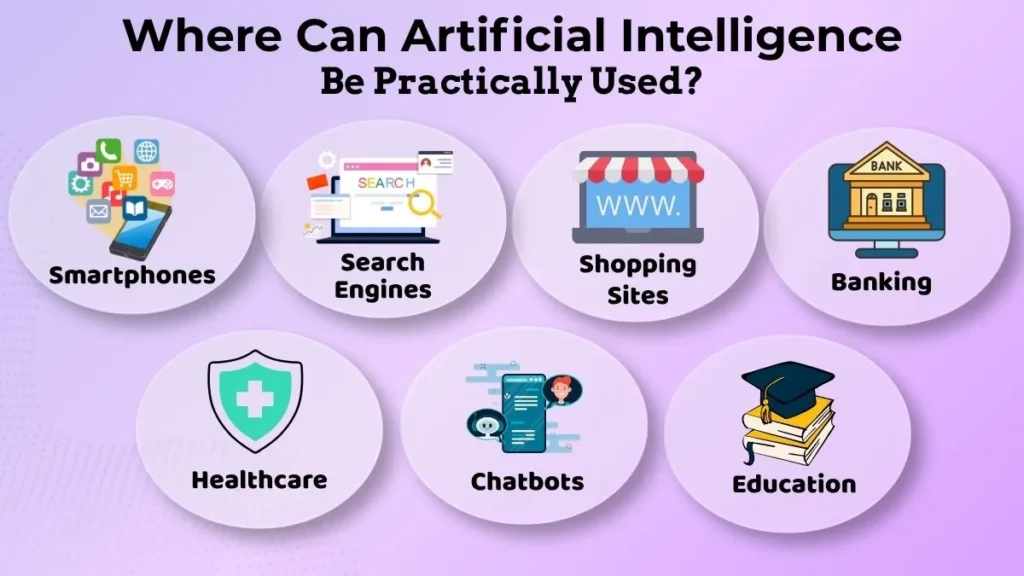
Artificial intelligence is no longer a thing only discussed among scientists in research labs.
We encounter it in our daily lives in numerous consumer electronics and services:
- Cell phones have AI to recognize faces, perform voice recognition, enhance photos, and more.
- Search engines use AI to understand what we want to find and give us relevant results.
- Shopping sites and video/music streaming services use AI to suggest products, shows, and songs based on our interests.
- Banks and other financial organizations use AI to flag suspicious transactions.
- Hospitals can use AI to help doctors in understanding medical scans and other information.
- Companies are using AI-powered chatbots to answer frequently asked questions from customers.
- Schools and online learning services can use AI to help students learn.
These are just a few examples of where AI is being used today, and its use is likely to expand into more industries as the technology develops.
What Are the Benefits of AI?
One of the biggest benefits of AI is the sheer power of computations it provides.
Something that would take a person hours or days to do may only take a fraction of second for an AI to do. AI can also reduce the amount of repetitive work people have to do.
For instance, instead of having to manually go through hundreds or even thousands of documents or transactions to find irregularities, an AI can scan through all of them in a matter of seconds and pull out only those that need to be looked at.
Other benefits include:
- Processing large amounts of information quickly
- Automating repetitive tasks
- Identifying patterns in data
- Giving people helpful suggestions
- Assisting in making decisions
- Answering simple questions
AI systems can also run continuously without needing breaks, which can be useful for certain automated tasks.
What Are AI’s Drawbacks?
Although it may be powerful, artificial intelligence is far from being perfect.
The outcomes of an AI system can greatly differ depending on the quality of data used for its training.
Moreover, one should remember that AI is not always accurate, and one should double-check any information provided by it.
Other limitations and concerns include:
- Privacy concerns
- Security risks
- Incorrect or misleading information
- Bias in AI systems
- Ethical concerns
- The possible impact of automation on certain jobs
What Is the Difference Between AI and Human Intelligence?
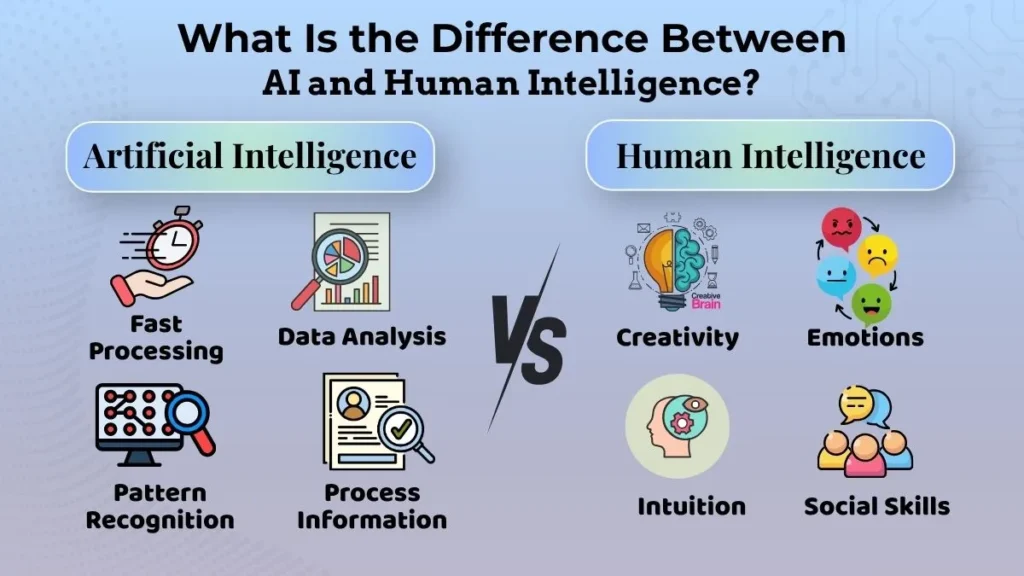
Compared to humans, AI can rapidly process information and recognize patterns.
However, human intelligence goes far beyond performing calculations.
Humans can also use intuition, emotions, personal experiences, creativity, and social skills while dealing with everyday situations.
To put it simply, AI is a technology designed to perform certain tasks that normally require human intelligence.
For instance, AI can process thousands of images within a fraction of a second, while a human can rely on emotions and social skills to identify a person’s mood. So, even when a machine appears to show impressive intelligence, that does not necessarily mean it is conscious or understands things in the same way a human does.
What Is the Future of Artificial Intelligence?
The future of AI will greatly impact the way people use technology around them.
AI is likely to become more deeply integrated into industries such as education, healthcare, entertainment, and software development.
People are already witnessing the power of AI in the way they interact with voice assistants, search the internet, generate texts and images, code software, and automate their daily tasks. Businesses are also finding new ways to use AI for tasks such as data analysis, customer support, content creation, and automation.
Some of the most promising fields for AI include education, healthcare, software, business, and entertainment, but it can also be integrated into day-to-day operations on a personal level.
However, as it gets more advanced, society should also worry about ethical concerns, including security, privacy, authenticity, and social impact.
Therefore, it is crucial for an everyday person to learn about the strengths and weaknesses of AI to be able to distinguish between authentic information and overblown marketing claims.
Conclusion
AI is a field of computer science that allows machines to perform tasks that normally require human intelligence.
It is already being used in many areas, including smartphones, banking, healthcare, education, and entertainment.
Its main purpose is to recognize patterns, perform calculations, analyze data, understand speech, and operate machinery. However, despite its numerous advantages, it may also create challenges related to privacy, security, and the possible impact of automation on jobs.
Pingback: Advantages and Disadvantages of AI Explained Simply
Pingback: Generative AI: Easy Guide for Beginners
Pingback: What Is ChatGPT and How Does It Work? Easy Beginner Guide
Pingback: What Is Google Gemini and How Does It Work? Easy Beginner Guide