
What Is Generative AI and How Does It Work? Beginner Guide
Introduction
Artificial Intelligence (AI) has been around for decades. However, recently, another form of AI has been garnering increased attention for its capacity to generate new content.
This unique form of artificial intelligence is known as Generative AI.
Generative AI can produce text, visuals, melody, audio, video content, and computer programs. One may have interacted with a Generative AI tool firsthand without realizing it. For instance, some chatbots provide responses to queries humans formulate, whereas other tools, such as image-generating software, create images based on a textual prompt.
In simple terms, What Is Generative AI?
Generative AI is a form of AI that learns patterns from training data and utilizes this information to generate new content.
Typically, conventional AI is programmed to scrutinize and evaluate information to obtain an answer. For instance, certain AI can observe and dissect an email message to ascertain whether it is spam or not. However, generative AI differs because it can be trained to accomplish more complex tasks, such as producing new content.
For instance, generative AI can be utilized to describe how a computer operates, write a short story, draft a product summary, and even design a segment of programming code.
Generative AI is not a database that instantly retrieves the response. Rather, it analyzes patterns and relationships between items, subsequently generating a response based on this information.
How Does Generative AI Work?
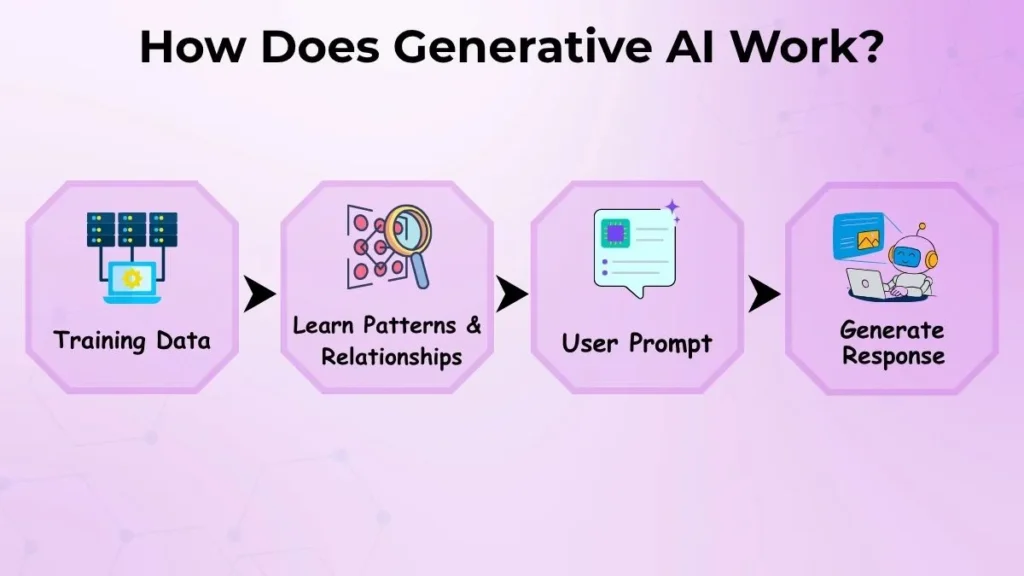
Generative AI tools are typically trained on extensive datasets. The nature of this information depends on the intended application of the AI. For instance, text-based AI, such as chatbots, are trained on large volumes of written material, whereas image-generating tools are trained on visual content and associated text descriptions.
While observing and learning patterns from this information, generative AI learns how different elements are connected. For instance, language-based AI tools observe how words combine, as well as sentence structure to determine what content to generate in response to a prompt. Ultimately, when provided with instructions, generative AI utilizes the information it has learned to formulate an original response.
For instance, when presented with a prompt “explain what is RAM to a student,” the generative AI tool will analyze the request and generate an appropriate response. The response will likely be an original production of the AI, as opposed to verbatim excerpts from the training dataset.
What Are the Types of Generative AI?
Generative AI can take many forms. The most obvious is chatbots, but there are other content types that generative AI can work with.
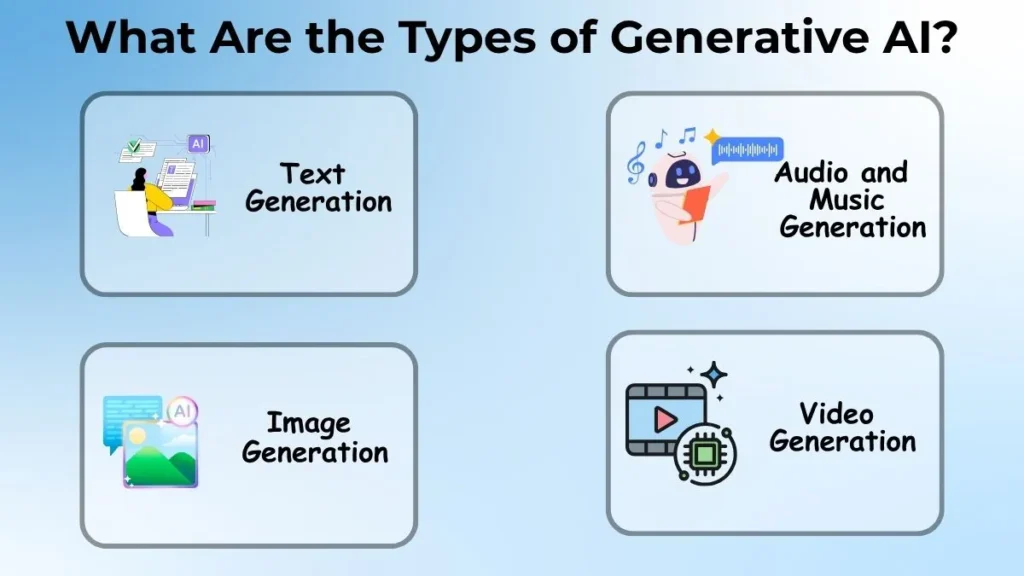
Text Generation
Text-generating AI can create various types of textual information. This can include emails, summaries, stories, articles, product descriptions, explanations, programming code, and more.
The above mentioned example of a chatbot falls under this category. For instance, a student can ask a chatbot AI to explain a certain computer-related concept instead of poring over pages of information.
Image Generation
An image-generating AI can create images from textual prompts. By inputting the desired description, a person can request an image similar to their prompt.
For instance, a person can describe a fictional city with flying cars and ask an image-generating AI to create an image based on this description. Image-generating AIs can also be utilized for prototyping, illustration, advertising, and experimentation.
Audio and Music Generation
Some AIs specialize in audio: generating synthetic speech, sounds, and even entire pieces of music. These AIs can take a prompt, which would be a description of the desired audio, and synthesize the requested sounds.
For instance, a person can utilize such an AI to generate a voice for a video or experiment with different musical styles.
Video Generation
Another type of content that some AIs can work with is video. The prompt for such an AI can either describe a short video that the AI will generate or alter an existing video.
This field is relatively new and has promising applications for videographers, advertisers, educators, and others.
What Is a Generative AI Model?
A Generative AI model is the system that synthesizes the requested information. In short, a model is a program that has been trained on a set of data.
It is important to note that there are many different types of models that utilize differing methodologies and produce different kinds of outputs.
Some AIs specialize in text, some – in images, audio, or video, and some can generate multiple types of media.
What Is a Prompt?
A prompt is a question or a request that a person asks of a generative AI. Most importantly, prompts are critical in getting a satisfactory response from a generative AI.
A prompt can be as simple or complex as the user wants, but the more detail and context the user provides, the better the result will be.
For instance, a request “Explain computers” is not as clear as “Explain the principles of how a computer works to a beginner.” The latter prompt provides the generative AI with a detailed description of what the user is looking for.
Where is Generative AI Being Used?
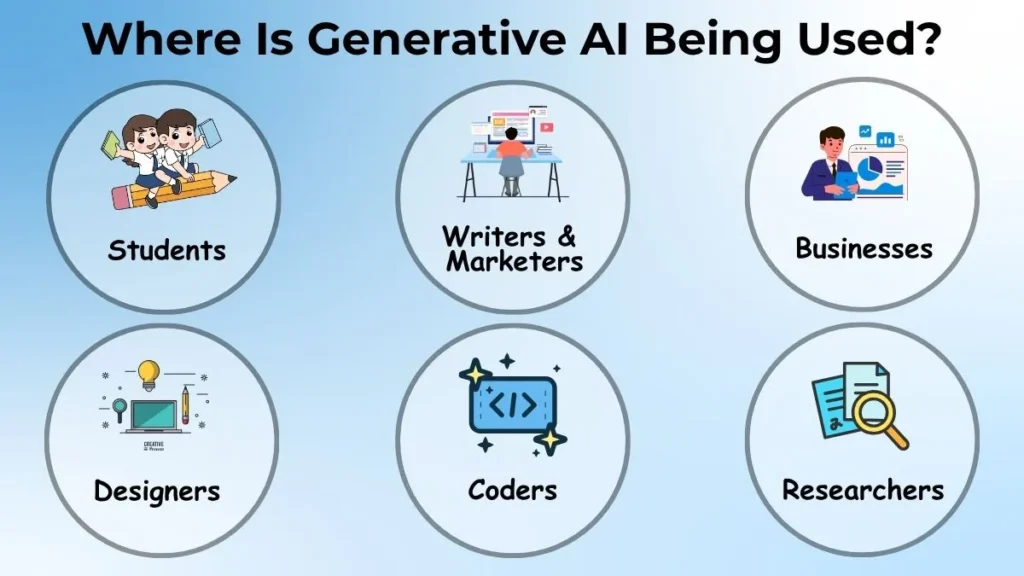
Generative AI can be applied in a variety of fields and for different purposes, both professional and personal.
Some of the most common applications are:
- Students can use it to understand new information, develop ideas, and find supporting materials for their studies
- Writers and marketers can use it to think of ideas and develop them into compelling content
- Coders can use it to generate code, understand errors, or learn about unfamiliar scripts
- Designers can use it to imagine and visualize new ideas in the form of images
- Businesses can apply it for customer service, communication, and other routine tasks
- Researchers can benefit from its ability to summarize findings, develop ideas further, and conceptualize a topic
The point is not to replace one’s skills and experience with AI but rather to delegate some time-consuming or stressful tasks to it to make the process easier or faster.
What Advantages Does Generative AI Offer?
The main advantage of using generative AI is that it can save time and effort, especially in monotonous, time-consuming, or hard tasks. A researcher might generate a rough draft for an article, a student could get ideas and develop a compelling presentation for class, or a coder could ask for an explanation of a confusing snippet of code.
Other benefits of generative AI include:
- Quick generation of a first draft, summary, or other content
- Brainstorming help in coming up with a new idea, examples, names, and other information
- Learning help for students or inexperienced professionals
- Quick completion of monotonous tasks
However, it is better not to rely solely on AI but rather ask for suggestions or a rough draft to then edit and improve the generated material.
What Are the Limitations of Generative AI?
While Generative AI can be very useful, the technology has its limits.
Answers generated by AI can contain false information, appear to be true even if they are not, and may fail to address what the user is actually asking for.
Other issues include topics such as privacy, copyright, bias, and misuse.
That is why information generated by AI should not be taken as absolute truth.
Other resources should always be consulted to find credible information.
Generative AI vs Traditional AI
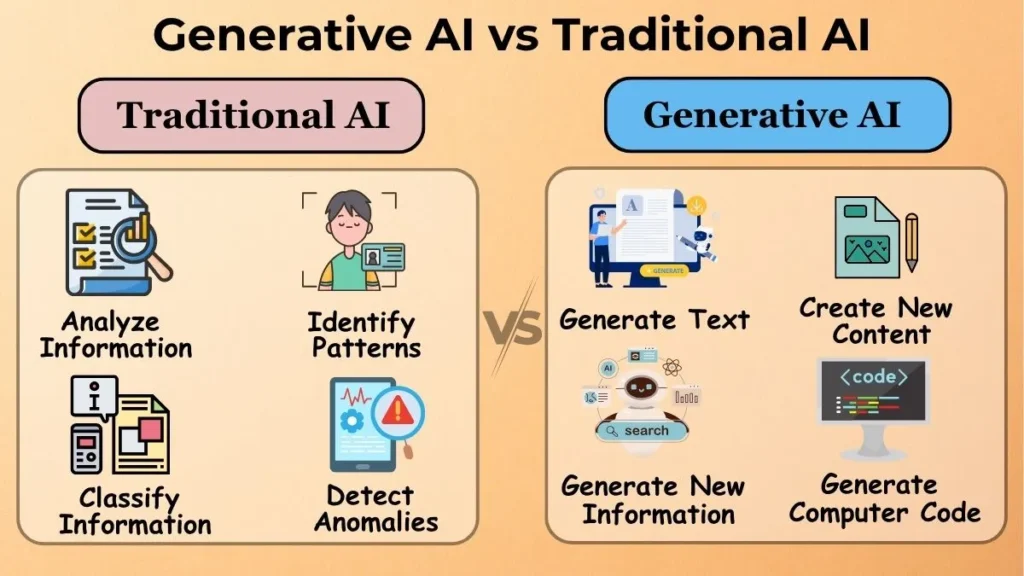
The primary distinction between Traditional AI and Generative AI is the intended purpose of each.
Traditional AI typically performs specific tasks like analyzing data or identifying patterns.
It may be used for classifying objects and information or detecting anomalies.
For example, a spam filter uses a traditional AI to scan an email and identify if it is spam or not.
In contrast, Generative AI is designed to generate new information.
It can be used to create text, audio, video, images, and computer code.
Using a similar example, a Generative AI can be used to draft an email instead of a spam filter analyzing the email for content.
In simple terms, traditional AI focuses on analyzing information while Generative AI creates information.
What Is the Future of Generative AI?
Many industries are embracing Generative AI. Fields such as education, programming, business, entertainment, design, and marketing are among those leveraging the power of Generative AI.
As this technology continues to evolve, it will likely become more advanced and versatile.
It will likely become more adept at analyzing and processing text, audio, video, images, and other data.
However, even if the technology becomes more sophisticated, it does not change the responsibility of users to use the technology ethically and responsibly.
As such, individuals using Generative AI should ensure that they are leveraging the technology correctly.
They should avoid sharing personal information with these tools.
In addition, they should ensure that they use the information provided by AI appropriately.
This includes double-checking any information produced by an AI and ensuring that it is factual and credible.
Conclusion
Generative AI is a form of Artificial Intelligence that leverages data to create new content.
This form of AI can be leveraged in different industries, from business to education and entertainment.
It can generate text, audio, video, images, and computer code.
It works by analyzing text and data to identify patterns.
Using that information, it can generate text based on the instructions given by the user.
The application ranges from helping students to find information for a research paper to helping a programmer write code.
However, it is not done without challenges.
The information generated by AI can often be inaccurate. In addition, it contains other ethical and legal concerns such as privacy and copyright. Understanding how it works and knowing its limits is crucial in ensuring that it is used correctly.