
What is CPU? Functions, Parts & Working Explained for Beginners
Introduction
Every time we use a computer in our daily life, while using it, several programs run in the background at the same time. Everything reacts fast whether we input anything, use apps, watch movies, or browse the web. Although everything appears easy from the outside, the computer is continuously processing commands on the inside.
The heart of all these actions is the CPU, and it is a very important component in every task. The CPU is also known as the “brain of the computer,” and this makes it easier for beginners to understand its function.
The CPU is responsible for nearly all computer functions, just like the way the human brain controls our bodies and behaviours. It analyses data, keeps track of instructions, and makes sure that tasks are done appropriately.
Even when a computer seems to be inactive, the CPU is still working in the background. The other important thing to understand is that any action that is performed on the computer, whether it is big or small, has to go through the CPU. This shows how much the CPU is involved in every process.
What Is a CPU?
Central Processing Unit is what CPU stands for. It is the primary part of a computer system that handles data and processes instructions.
In simple terms, the CPU takes input, processes it, and helps in producing output. It is like a control center that connects different parts of a computer and makes them function.
The CPU follows instructions step-by-step whenever you type, click, or open a file, among other actions. It ensures that the right output appears without any delay.
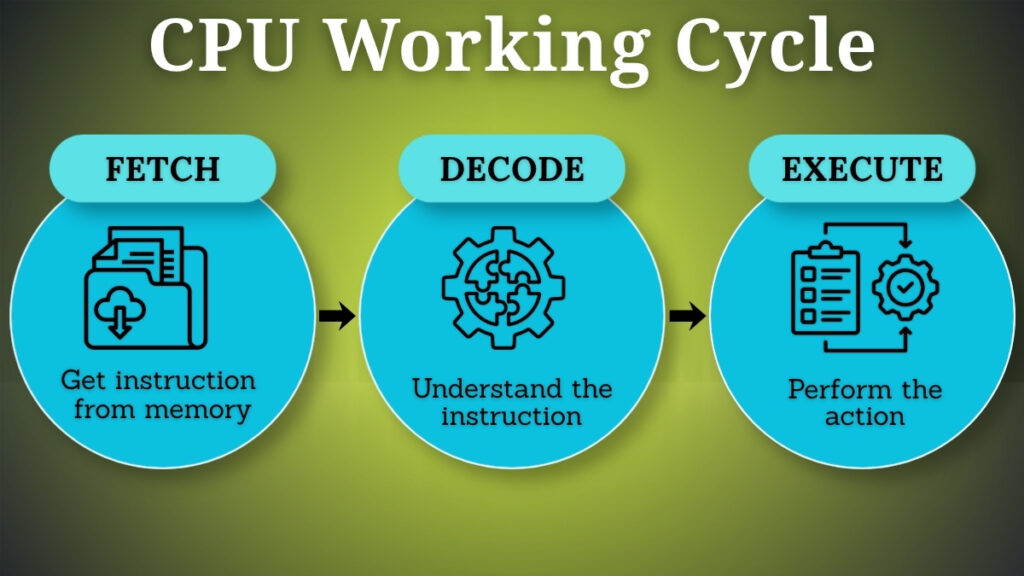
The CPU does not function at random. It follows a proper sequence of fetch, decode, and execute. This happens very fast, that is why the user feels that the system is responding instantly.
A computer cannot perform any function without the CPU. It wouldn’t be able to read or execute a program. For all these reasons, the CPU is considered as one of a computer’s most important components.
Main Functions of CPU
The CPU carries out various important tasks that enable the computer to function correctly. Although the user may not be able to see them, these processes are running inside continuously.
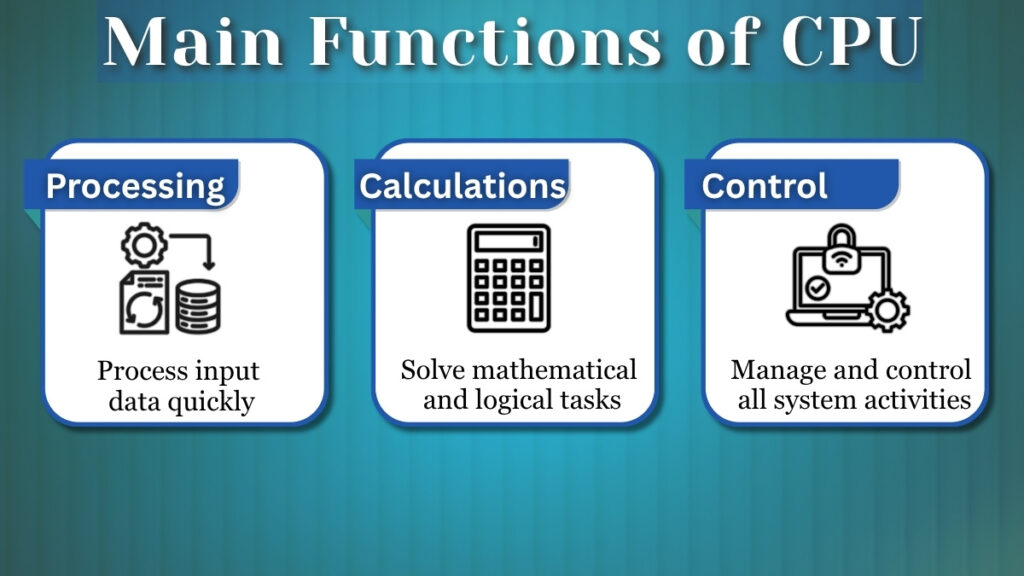
1. Processing Data
Data processing is one of the main functions of the CPU.
Every time data is input into the computer, the CPU reads and processes it using a set of instructions provided. The process is fast and is able to undertake several tasks within seconds.
Accuracy is applied to even the smallest activities. For example, when you enter a sentence, the CPU reads the sentence and processes each keyword. It also makes sure that it displays results accurately and quickly on the screen.
The other thing that should be understood about the computer’s Central Processing Unit (CPU) is that it executes instructions in order. The CPU takes one instruction after another at an extremely fast speed, which makes it appear that several things are being done simultaneously.
2. Performing Calculations
Calculations are also carried out by the CPU.
Depending on the task, these calculations may be simple, like addition or subtraction, or more complex. Additionally, it carries out logical functions including decision-making and comparison.
For example, the CPU do calculations extremely fast when you use a calculator or run a software that includes numbers.
These calculations are not just about numbers. Logical checks, including comparing numbers or verifying program conditions, are likewise carried out by the CPU. This is what enables software to respond appropriately to various situations.
3. Controlling Computer Operations
One more important function of the CPU is controlling all actions performed by the computer.
The CPU acts as a manager controlling various units. It issues commands to memory units, input and output units, etc., ensuring proper functioning.
Without this coordination, different units of the computer will be unable to communicate with each other, and the tasks will not be finished properly.
The CPU continuously manages and directs their tasks because every part of the system works in coordination. It also helps in avoiding any misunderstandings between units.
Basic Parts of CPU (Simple Overview)
Smaller internal parts of the CPU enable it to carry out its functions effectively. Let us understand the parts of CPU in a simple way.
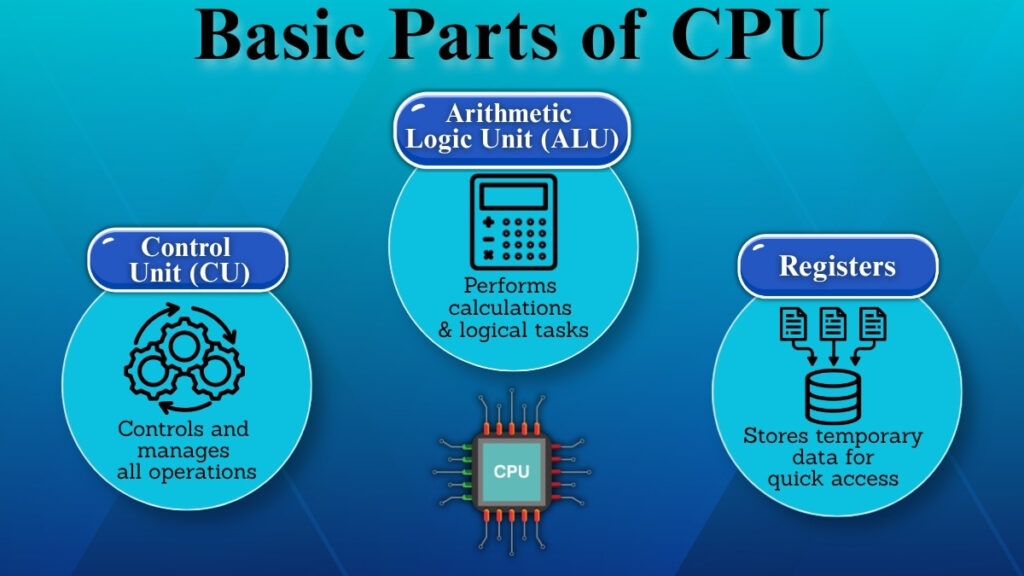
Control Unit (CU)
All computer processes are controlled and managed by the Control Unit.
It manages the data and instruction flow between various parts. It gives instructions to the system that what to do, when to do it, and how to do it.
All parts of the computer work together smoothly without conflict because of this coordination.
Arithmetic Logic Unit (ALU)
Calculations and logical processes are handled by the Arithmetic Logic Unit.
It performs operations such as addition, subtraction, comparison, and basic decision-making processes.
The Arithmetic Logic Unit (ALU) performs calculations and logical checks with speed and accuracy.
Registers
Inside the CPU there are registers which are small and have high-speed storage.
They temporarily store data and instructions that are being processed at that moment. It helps the CPU have quick access to necessary data without any interruptions.
Since registers are located within the CPU itself, they are faster than other types of memory. That is the reason why they are only meant for temporary storage purposes.
Role of CPU in Daily Computer Use
Almost every task performed on a computer in daily use involves the CPU.
For example, when you type a document, the keyboard provides input data, which is then processed by the CPU and displayed on the screen. All this happens quickly and continuously.
In the same way, the CPU executes all instructions in real time when you open apps, browse the web, or watch movies.
The CPU continues to handle background tasks such as system updates, notifications, and security processes even when you are not actively using the computer.
Why CPU Is Important for Performance
The speed at which a computer operates mostly depends on the CPU.
Tasks such as opening apps, switching between tabs, and running software become easier. This happens because of a faster and more efficient CPU which processes instructions quickly and also makes the system smooth and responsive.
On the other side, if the CPU speed is low, then the computer performance would be slow or would require more time to process commands. Even simpler actions will appear to be taking too long.
There are other issues such as multitasking, which also rely on the efficiency of the CPU’s instruction handling. The faster the CPU, the more actions that can be done simultaneously without any delays.
Thus, CPU is the main component which controls and manages every function. Without it, the process is not complete.
CPU vs Human Brain (Simple Understanding)
The comparison of the CPU with the human brain makes it easier to understand this topic.
Firstly, the brain can think, learn, and adapt. It can make decisions independently without any specific instruction received from outside.
On the other side, the CPU functions following instructions, and cannot think or make independent decisions. It always strictly follows the command issued by the user.
This comparison helps beginners to understand that the CPU is a device which manages, controls, and performs functions quickly but it still depends on user input and software instructions.
Basic Care and Safety Tips
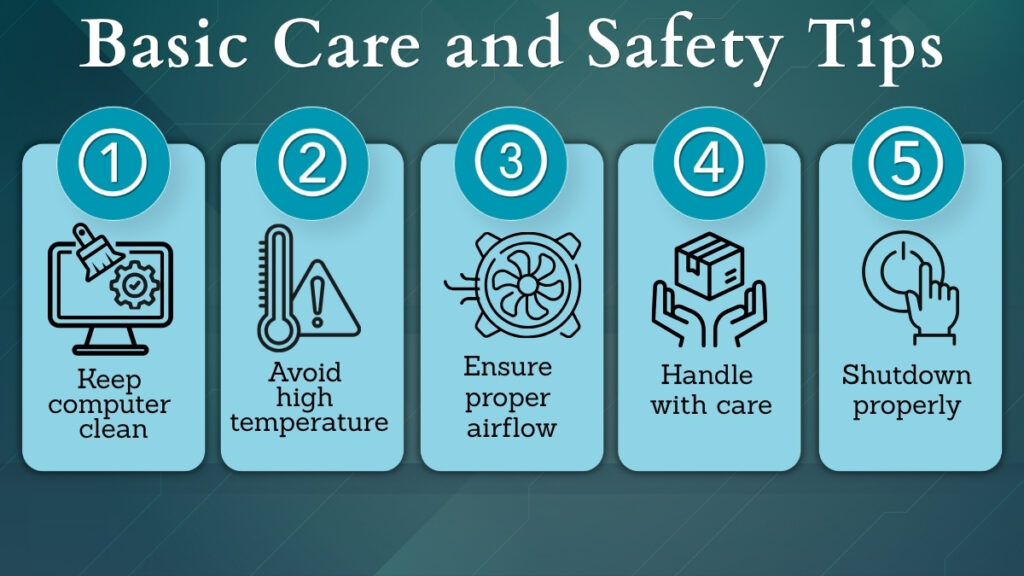
The maintenance of the CPU and computer will be essential for long-term performance.
-
Place the computer in a clean area
-
Avoid placing the computer in a high-temperature area
-
Avoid blocking air ducts in the computer
-
Handle the computer carefully
-
Shutdown the computer properly
Over time, these easy tips help preserve performance and avoid harm to the computer.
Conclusion
The CPU is the most important part of the computer. It manages and executes all the functions of the computer.
Without a CPU, no function can be completed on a computer. It performs almost all activities from opening applications to typing texts.
With technological improvement, CPUs have become more advanced, and therefore, they are now capable of executing tasks faster and more efficiently.
For beginners, understanding the CPU is essential because it builds a strong foundation for learning about computer hardware.
Thus, a computer cannot run without a CPU. It is one of the most important components in the system.