
Multitasking and Multiprocessing Operating Systems Explained
Introduction
Computers of today can do several tasks simultaneously. The user can browse the web, play music, start applications, and even type documents at once without pausing on one action before beginning another one. This is made possible due to how modern operating systems have been developed to process tasks.
In everyday activities, multiple applications are used simultaneously. For instance, a student may be attending a virtual class, making notes, and conducting research on the internet. In the same way, office workers could be writing a document, downloading other documents, and communicating online. The process is executed seamlessly using the operating system.
Modern operating systems have several techniques for boosting their efficiency. While some systems concentrate on multitasking, others increase their efficiency by utilizing more than one processor.
Such computer operating systems are called multitasking and multiprocessing computer operating systems.
Both are associated with improved performance; however, both are different from each other. Multitasking operating systems mainly deal with managing many tasks at once, whereas multiprocessing operating systems increase efficiency by employing multiple processors to execute tasks.
The knowledge of these operating systems is very essential for beginners as it helps to understand how modern computers efficiently manage tasks as well as perform effectively.
In this article, we will explore what multitasking and multiprocessing operating systems are, their working, advantages, drawbacks, and practical applications.
What Are Multitasking and Multiprocessing Operating Systems?
Multitasking operating system and multiprocessing operating system refer to those operating systems that work towards improving computer task management.
To put it simply, multitasking operating systems have the capability of managing several tasks simultaneously whereas multiprocessing operating systems use multiple processors for improving task management and performance.
Both of these operating systems are developed to increase efficiency and make using computers easier.
For instance, when users use several applications at once, the process of multitasking will help in managing the tasks efficiently. Meanwhile, in cases where several processors are required to handle a large workload, then it can be done with the help of multiprocessing.
While, they have different ways of functioning, they are both useful in making computers perform faster and more efficiently.
Computers nowadays often use elements of both these systems for efficient functioning.
Now, let us learn about both these operating systems individually in a simplified manner.
What Is “Multitasking Operating System”?
A multitasking Operating System enables a computer to perform several tasks simultaneously.
As compared to the traditional system where a computer can run only one application, a multitasking operating system enables several applications to function simultaneously.
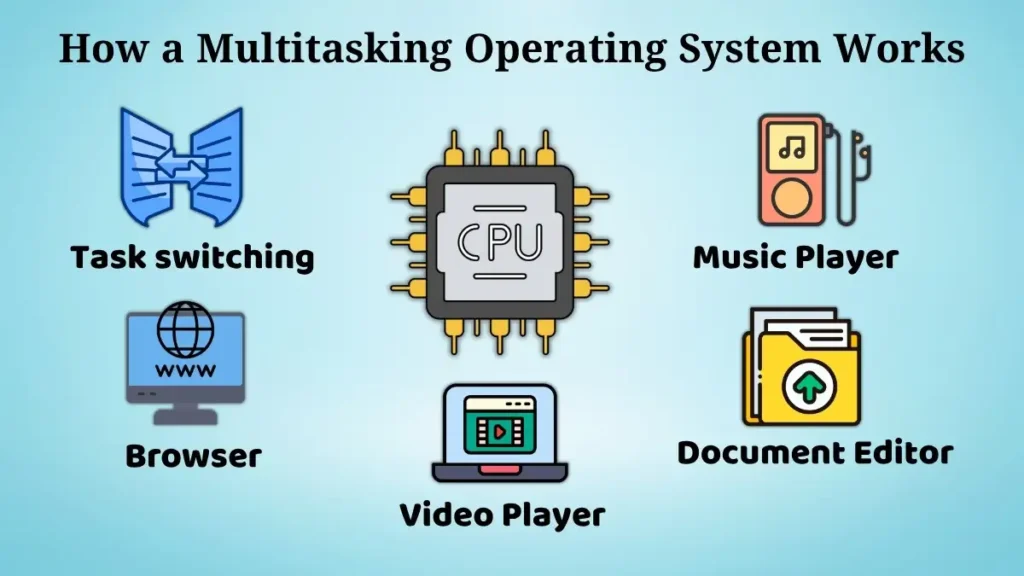
For instance, a user would be:
- Playing music,
- Browsing internet,
- Watching movies,
- While working on a doc file,
all at once without stopping one application to start another.
Such operating systems make things easier and improve efficiency since the user will be able to perform various tasks at a time.
Some examples where multitasking operating systems are applied include:
- Personal computers
- Laptops
- Smartphones
- Tablets
Users rely greatly on multitasking in modern times because multitasking is generally associated with using the computer each day.
For example, while downloading files, users will be able to browse the internet or work on documents concurrently.
Multitasking allows users to perform many tasks at once instead of waiting for one task to be completed first.
What is the operation of a multitasking operating system?
The multitasking operating system achieves multitasking through the switching of tasks at a very high speed.
While many processes seem to execute simultaneously, the operating system accomplishes this through allocation of processing time for each process in small quantities repeatedly.
The process is so quick that the users feel that all programs are running simultaneously.
For instance, even if music is playing in the background, the user can type and browse the internet without any interruptions.
The following operations are managed by the operating system:
- Program execution
- Duration of processing
- Memory management
- Connection of resources with the system
This kind of management guarantees that no task blocks other tasks.
If many applications are being used simultaneously, the operating system allocates its resources evenly in order for optimal performance.
With such management of tasks, multitasking operating systems become efficient.
Benefits of an Operating System for Multitasking
Many benefits are provided by a multitasking operating system.
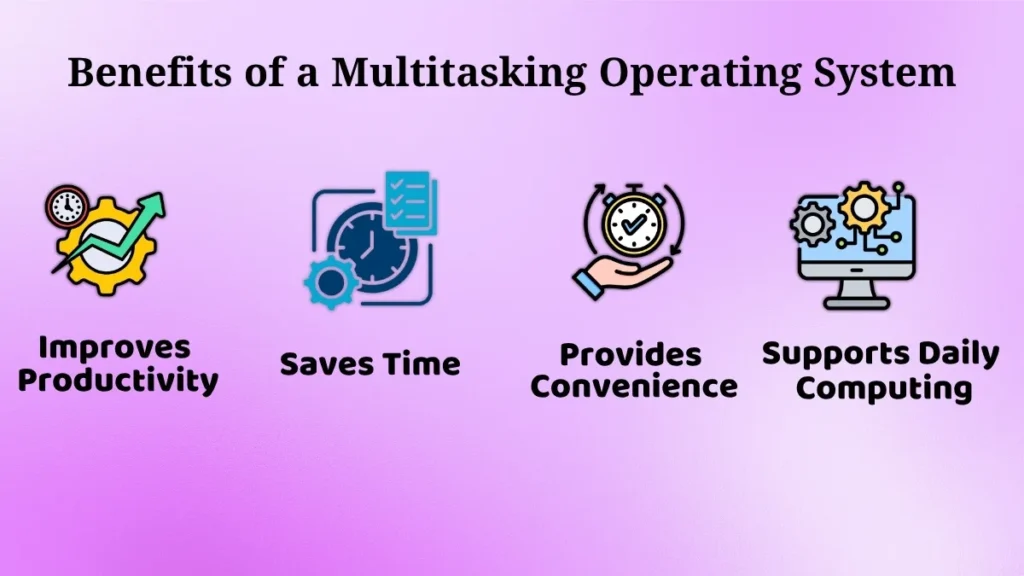
Improves Productivity
Without wasting time, users can complete various tasks at one time.
For instance, students can simultaneously prepare notes and attend online classes.
Saves Time
Delays can be minimized by carrying out many activities concurrently.
For example, while users are working on other tasks, files might download in the background.
Provides Convenience
Users do not have to stop using one software before beginning another.
This makes using a computer more convenient and flexible.
Supports Smooth Daily Usage
Multitasking is essential for many modern computing tasks, including communication, entertainment, online education, and professional work.
Without multitasking today’s computer use would be less effective.
Limitations of a Multitasking Operating System
While multitasking offers many benefits, there are certain drawbacks.
Too Many Tasks Can Slow Down the System
The system may become slow if several apps run concurrently due to the division of resources among numerous tasks.
Performance Is Related to System Capability
Hardware that isn’t as strong may cause problems while multitasking heavily.
For instance, an older computer may slow down when many programs are opened simultaneously.
Heavy Applications May Affect Smoothness
A big application like a game or editing program can lower computer performance if many programs run at the same time. However, multitasking is one of the most beneficial capabilities of an operating system.
What Is a Multiprocessing Operating System?
A multiprocessing operating system uses more than one processor to accomplish tasks.
Rather than being dependent on a single processor, the operating system is designed to use multiple processors for the task.
The function of a processor is to process instructions and calculation within the computer. The use of various processors leads to load sharing by these processors.
This makes the computer perform much better.
Multiprocessing operating systems are typically employed in situation where good performance is important, like for example:
- Big corporations
- Data processing facilities
- Scientific computation facilities
- Industrial environment
These environments may require processing capabilities exceeding those provided by one processor alone.
Multiprocessing offers several benefits in such situations, including increased efficiency and speed.
How a Multiprocessing Operating System Works
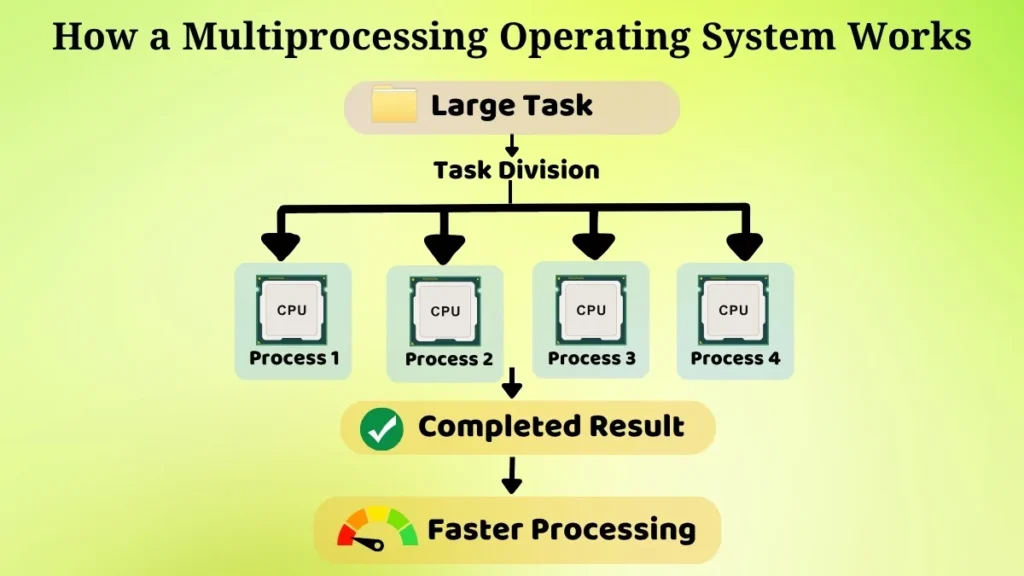
A multiprocessing operating system splits tasks into several processors.
Instead of having one processor perform all operations, the OS assigns different tasks to several processors.
This lowers the burden on the individual processors, enhancing system performance.
For instance, when a number of tasks require processing together, various processors will process various components simultaneously.
This serves the following purposes:
- It enhances speed
- It minimizes delays
- It increases efficiency
- It makes it easy to manage large tasks
Multiprocessing can be compared to teamwork, whereby various people share workload among themselves rather than doing everything individually.
An operating system controls processors in such a manner that facilitates proper completion of tasks.
Advantages of a Multiprocessing Operating System
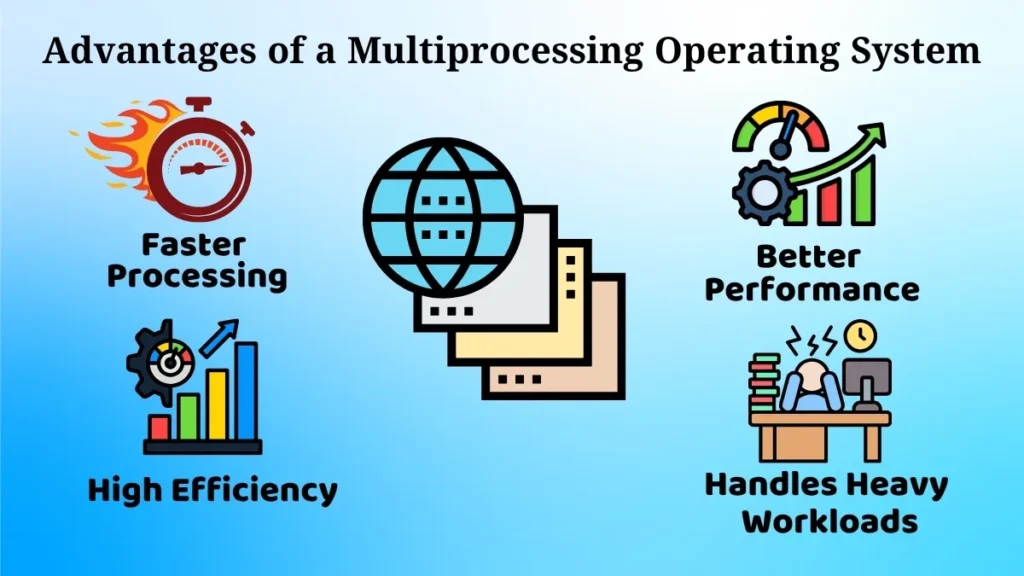
There are several benefits of multiprocessing operating systems.
Improves Overall Performance
The speed and efficiency of the system are enhanced by many processors.
When compared to computers with a single processor, heavy tasks can be finished more quickly.
Handles Heavy Workloads Efficiently
High workload can be shared between the processors, thus relieving a particular processor from doing everything.
Multiprocessing is ideal for high-level systems.
Supports Faster Processing
The cooperation of several processors enables faster completion of tasks.
It increases system responsiveness.
Improves Efficiency in High-Performance Environments
Multiprocessing is very appropriate for environments that require continuous processing and performance.
Limitations of a Multiprocessing Operating System
Additionally, multiprocessing systems have certain drawbacks.
More Complex to Manage
Management of multiple processors needs effective coordination and efficient management of the system.
This leads to increased complexity of the operating system.
Requires More Resources
Multiprocessing systems need extra hardware support.
This raises the system requirements.
Higher Cost
Multiprocessor systems cost higher compared to basic computer systems.
Despite these disadvantages, multiprocessing systems are extensively used wherever improved performance is needed.
Difference Between Multitasking and Multiprocessing Operating Systems
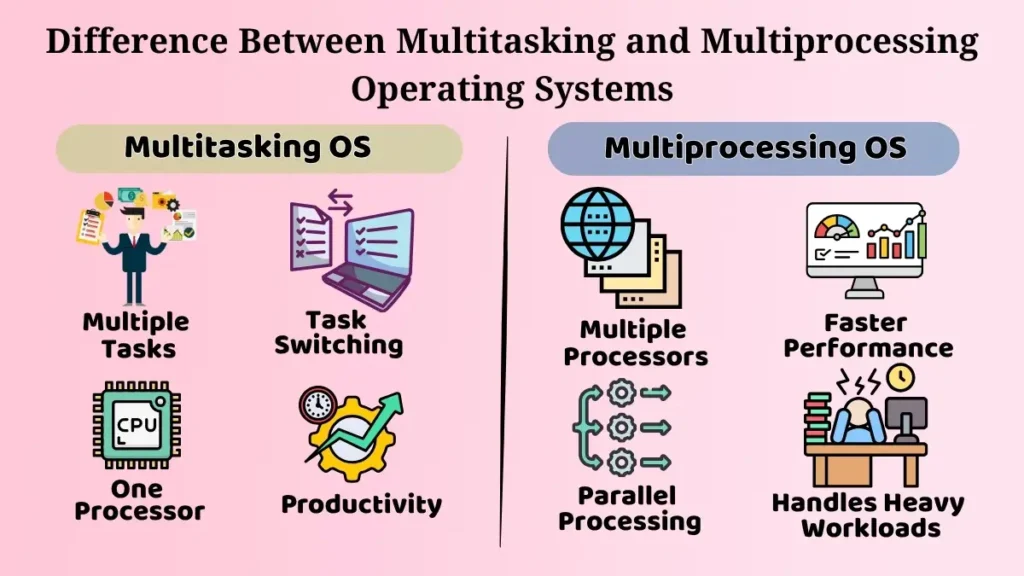
Differences between a multitasking and multiprocessing operating system lie in how they improve performance.
Multitasking operating system focuses on multitasking processes within the system.
These processes may involve:
- Browsing the web
- Watching movies
- Playing music
- Typing documents
On the other hand, a multiprocessing OS focuses on taking advantage of multiple processors to increase processing power.
Another major difference between multitasking and multiprocessing operating system is that multitasking operates in a single processor system, but multiprocessing doesn’t.
Multitasking mainly enhances usability while multiprocessing enhances processing power.
Understanding these differences will be helpful to beginners in appreciating how operating system handle different tasks in computer systems.
Real-Life Examples of Multitasking and Multiprocessing Systems
In daily life, multitasking operating systems are often utilized.
For example:
- Using the internet and listening to music at the same time.
- Participating in virtual meetings while taking notes.
- Watching videos while downloading files.
- Mobile phones and personal PCs both have these apps.
When efficiency is crucial, multiprocessing operating systems are frequently used.
As an example:
- Science-related computer systems
- Large firms
- Information hubs
- Commercial computers
These kinds of applications require very efficient processing and load control.
Beginners will learn how to utilize both types of operating systems in a variety of situations with help of real-world examples.
Why Understanding These Operating Systems Is Important for Beginners
The topic of multitasking and multiprocessing operating systems is essential for beginners.
Some major advantages are as follows:
- Understanding of computer performance
- Understanding how modern computer systems handle tasks
- Strong base for future studies
- Better understanding of complex computer systems
The information gained will help beginners to understand how modern computers carry out multiple operations smoothly.
This will also provide confidence while learning other aspects of computing in the future.
Conclusion
It is essential to have a multitasking and multiprocessing operating system in today’s computer environment.
The multitasking operating system enables multiple programs to be operated by the user to maximize productivity.
On the other hand, the multiprocessing operating system uses several processors to enhance efficiency in performing various operations.
Both operating systems enable increased efficiency and speed.
It is essential that beginners understand this concept before being able to understand how computers work and how they execute tasks.