
What Are AI Agents and How Do They Work? A Simple Guide
Introduction
Let’s say you’re organizing a weekend getaway and don’t have much time to arrange your schedule, research potential destinations, and find the best hotel rates. An AI chatbot could undoubtedly provide you with some advice, but what if it could search for hotels, compare rates, organize the data, and assist with booking?
The fundamentals of an AI agents are as follows. AI agents are able to move closer to their objective. This can be accomplished by using AI to analyze instructions, make decisions, and engage with tools.
AI agents are becoming very useful in fields such as business, research, software development and general productivity. Let’s look at how they work.
What Are AI Agents?
A system that seeks to accomplish a task is called an AI agent. They are able to make decisions, collect information, comprehend instructions, and act.
If you asked an AI agent to assist you plan your study time, for instance, it might take a look at your subjects and time limitations and make a schedule. If it had access to the right resources, it could also add study times to your calendar.
Before deciding how to help you, many AI agents employ language models to better grasp your needs. They might also use and store data, engage with technologies, and follow to regulations.
Not all AI agents will be the same. While some may perform several tasks automatically, others will require authorization before making any modifications or searching for information. Everything depends on the tasks they have been given.
How Do They Work?
They usually follow a cycle of understanding, planning, carrying out actions and reviewing.
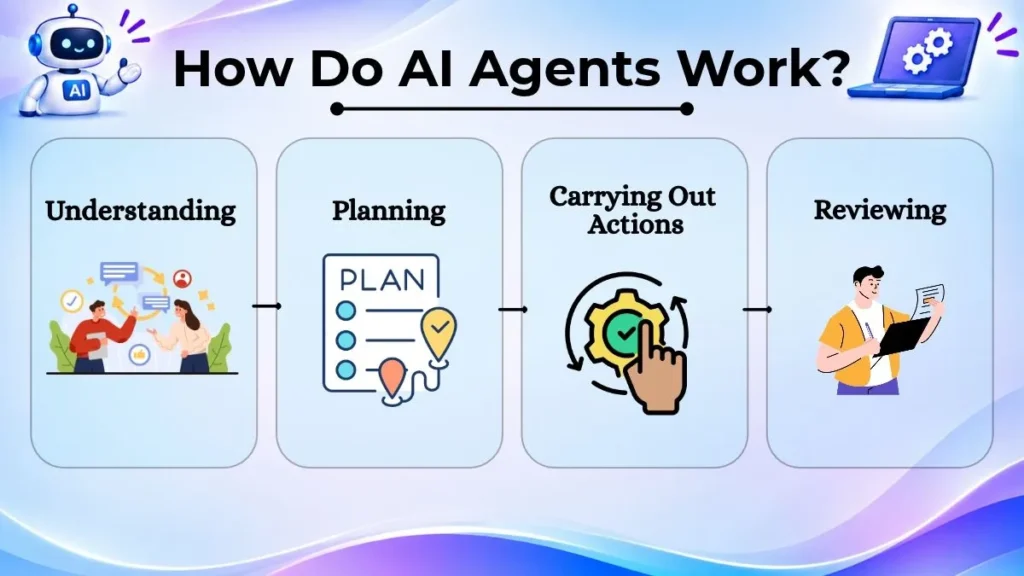
Understanding
The AI agent will first learn what you want it to do. They have to know your needs and any crucial specifications.
For example, if you asked them to set up a good time for your team meeting, they would need to know how long it would last, who would be there, and any preferences.
They might ask inquiries to help gather more information if it’s unclear or there isn’t enough.
Planning
If they have an understanding of what you require, they will be able to plan on how to accomplish your requirements. In case they have a complicated requirement, they will have to break it down.
For example, they might look at everyone’s calendars and create a list of times that work for everyone.
They will be able to determine exactly what has to be done as a result. They may revise their plans based on new information or any arising issues.
Carrying Out Actions
Once they have a plan they can complete the actions using any tools available. This could be things like a browser, database, calendar, email provider, API or other software.
For instance, when they assist you in conducting some research using the internet, they can look up the information, browse through the necessary sites, gather the information and compile it into an informative summary.
However, if they don’t have access to these tools, then all that they will be able to do is explain how they would work on your task. Everything will depend upon what tools they have access to.
Reviewing
Just because they’ve completed an action doesn’t mean it’s completed successfully. AI agents may need to check if they’ve done what they wanted.
For example, if they were looking for meeting times but couldn’t find any that worked for everyone they may look for alternative times or ask if you can change how long the meeting lasts.
This helps them complete complex tasks. They will stop performing tasks when they have achieved their objective, reached a boundary point, or require human assistance.
What’s the Difference Between Chatbots and AI Agents?
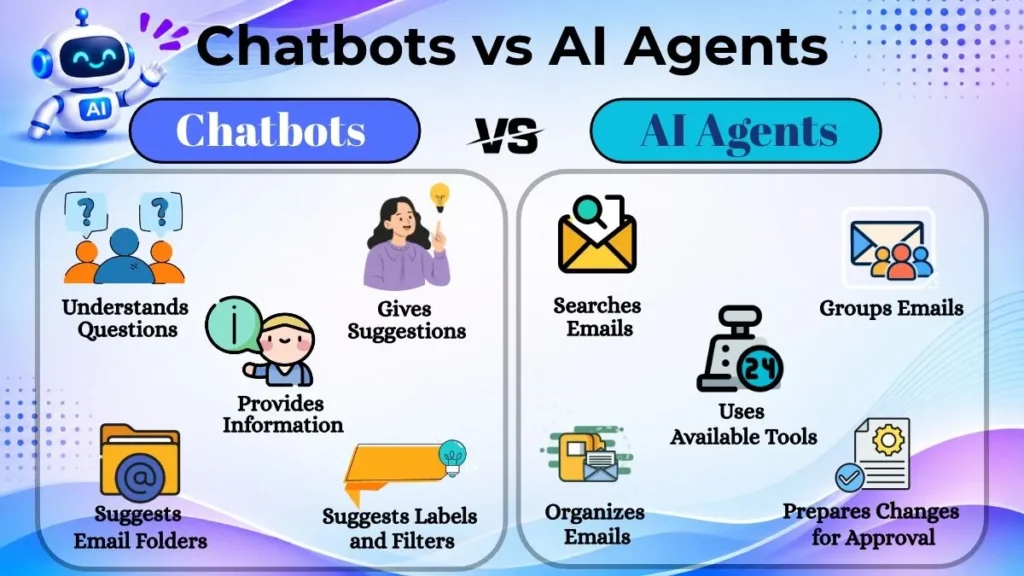
Both chatbots and AI agents can understand questions and provide helpful answers. However, they’re created differently.
A chatbot may tell you how to organise your inbox by suggesting folders, labels and filters. An AI agent with access to your email may be able to look for emails using these rules, group them and create changes for you to approve.
A chatbot will often provide information, whereas an AI agent can be set up to take actions using the information.
However, chatbots can now do a lot more. They can browse websites, use tools and complete complex tasks. Some AI assistants have elements of both.
Where Can They Be Used?
Depending on how they’ve been set up, and what tools they have access to, an AI agent can help with a variety of tasks. Below are some common uses.
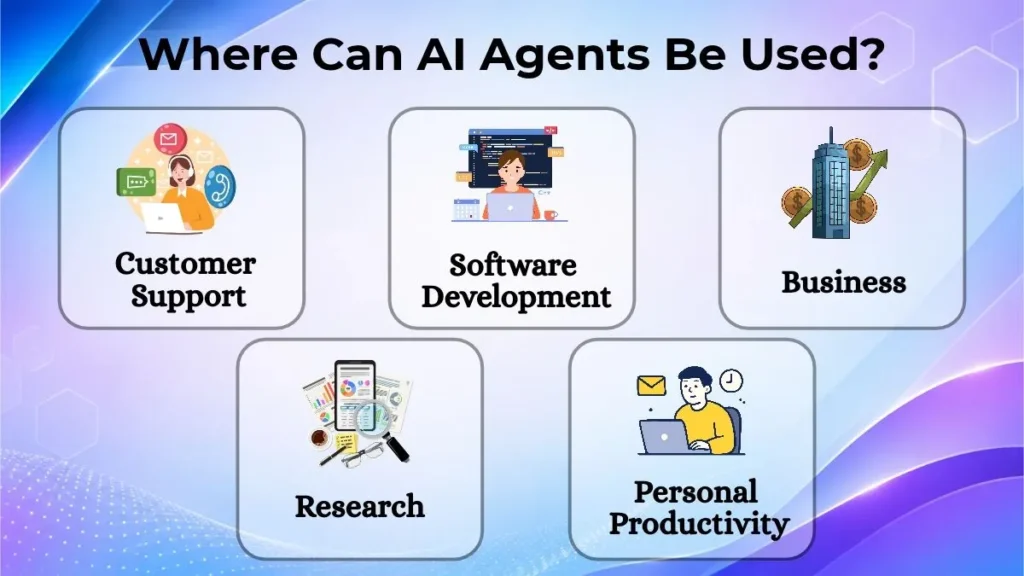
Customer Support
They can answer common questions, look up relevant information from your account, and pass complex issues to a human.
Business
They can help to organise documents, complete repetitive tasks, collect information and create reports.
Software Development
They can look through code, suggest fixes, and run tests (if they have permission). This can help developers investigate issues.
Research
They can search for information, compare sources and organise the information.
Personal Productivity
They can help with organising schedules, creating to-do lists, managing information and organising daily tasks.
For example, a developer could use an AI agent to help investigate an issue within their software. The agent may look through the relevant code, suggest a fix, and run tests (if it has permission).
They can help with repetitive tasks, however they still depend on accurate information and good tools.
Main Types of AI Agents
There are a few different types of AI agents.
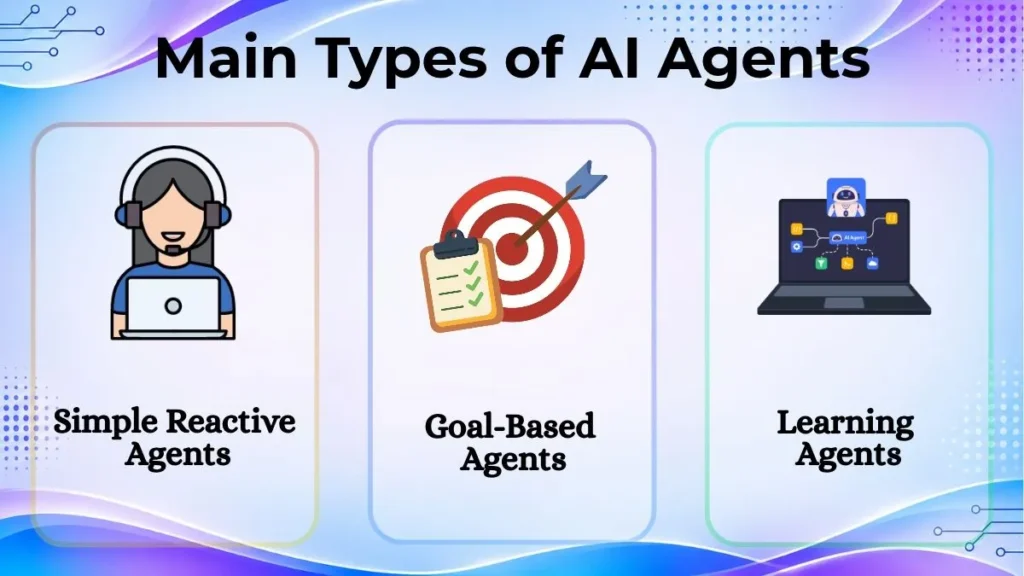
Simple Reactive
They react to situations based on rules. This can be useful for simple tasks where you know what the response should be.
Goal Based
They will carry out actions based on a goal. For example, a navigation system may look at different routes to help you reach your destination.
Learning
They learn from feedback or experience. Their performance may improve if they get useful data. However, this doesn’t mean they will always give correct answers.
Some advanced systems will have multiple AI agents working together. One may collect information, one may analyse it and one may organise the final report.
This shows the different ways they can be created. However, an AI system may contain a mix of different types.
Limitations of AI Agents
Whilst they can help complete useful tasks automatically they can sometimes not be reliable. They may misunderstand instructions, provide incorrect information, or make the wrong decision on what action to take.
They may also struggle if something unexpected happens. If they’re looking to complete a standard task but the layout of a website has changed, or the information isn’t available they may struggle.
There can also be issues with security and privacy. If they have access to your email, business information or personal accounts it could be an issue if they make the wrong changes or aren’t given clear instructions.
They should only have limited permissions, clear rules and be monitored correctly. Important actions such as sending sensitive emails, changing financial information or deleting files may need to be approved by a human.
Important results should also be reviewed by the user. Therefore, they can help save time, it still need careful monitoring.
Future of AI Agents
AI agents play an important role in AI development. They can link intelligent systems to real world tasks. People may become more reliant on them to help them complete a range of tasks within one workflow.
For example, a business may use them to collect sales information, create a report and organise it for a team meeting. In software development they may help developers investigate bugs.
However, they need to become reliable, keep private information secure and deal with unexpected situations.
Humans will still be important when using them. Systems which have the right balance between automation and controls will be the most useful.
Conclusion
AI agents are systems which aim to complete goals by understanding instructions, planning, carrying out actions using available tools and reviewing. Unlike systems which provide answers they can complete a series of actions if they have the right capabilities and permissions.
They can help with many tasks such as organising schedules and helping with software development. They can also make mistakes and need the right precautions.
Knowing how they work can help us understand where they can be useful and why we should monitor them. As this technology develops it will be important to consider how reliable and safe they are.