
How Does Perplexity AI Work and What Is It? A Beginner-Friendly Guide
Introduction
When you need an answer online, the standard method involves typing your question into a search engine, opening a few results, and reviewing different websites until you find what you need. This works, but it can take a longer time than one might expect.
Perplexity AI offers a slightly different approach. It combines web search and artificial intelligence to identify relevant information and presents it in the form of a direct answer. It avoids merely providing a list of links and instead offers an explanation of the topic with citations linking back to the sources of the information.
Perplexity describes itself as an AI-powered answer engine, with capabilities ranging from answering simple questions to performing research tasks that require identifying information from a number of different webpages.
Search for an Answer, Not Just a List of Links
The basic premise of Perplexity AI is rather simple: ask a question, and instead of forcing you to sift through search results, it pulls together information that could help answer that question.
For instance, if you need to understand the differences and similarities between two programming languages, searching for separate articles about those languages would be tedious. Instead, Perplexity AI could be asked to compare the two directly – its features allow it to search for relevant information and then summarize it along with providing citations to the sources.
What Happens When You Ask Perplexity a Question?
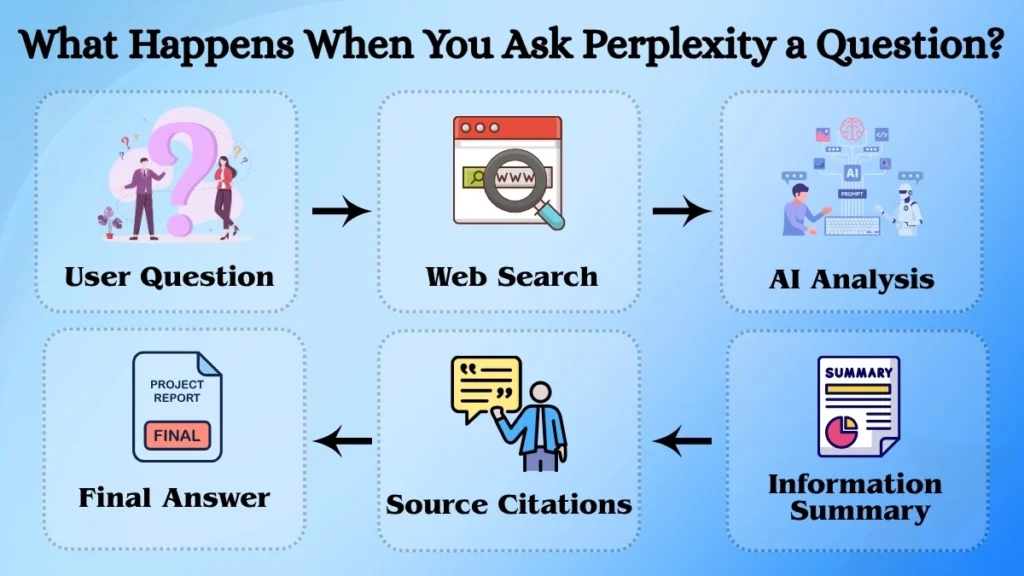
It Understands Your Question
It all starts with a query or directive from you. First, Perplexity AI evaluates the input to identify what information it might need to provide. A common query such as ‘What is cloud computing’ would be easier to answer compared to something like “Compare the latest cloud storage options for students based on price and storage.”
It Searches the Web
Based on the question, Perplexity AI can now either proceed to search the web or utilize its research-oriented tools. In particular, it favors searching the web when the information requested could change over time. For more involved questions, its research-oriented tools can perform several searches in order to identify the most relevant pieces of information.
It Brings the Information Together
Once Perplexity AI has found information, the next step is to analyze and summarize it. This can be useful, as it avoids the need to spend time on a number of webpages trying to identify how the information presented there might be relevant to one’s question. In practice, the output is likely to be much more structured, with the key points mentioned explicitly.
It Shows Where the Information Came From
Citations are one of the most eye-catching elements of a Perplexity answer. Sources are attached to an answer to show where a piece of information specifically came from.
You can open the cited source and read it if you want to get more information or verify something. This is particularly good if you are going to be doing research, instead of just asking a quick question and getting a short answer.
From Quick Questions to Deep Research
Not every question asked requires the same amount of research. Perplexity AI is built to handle simple queries and complex ones that might take a bit more time to parse through.
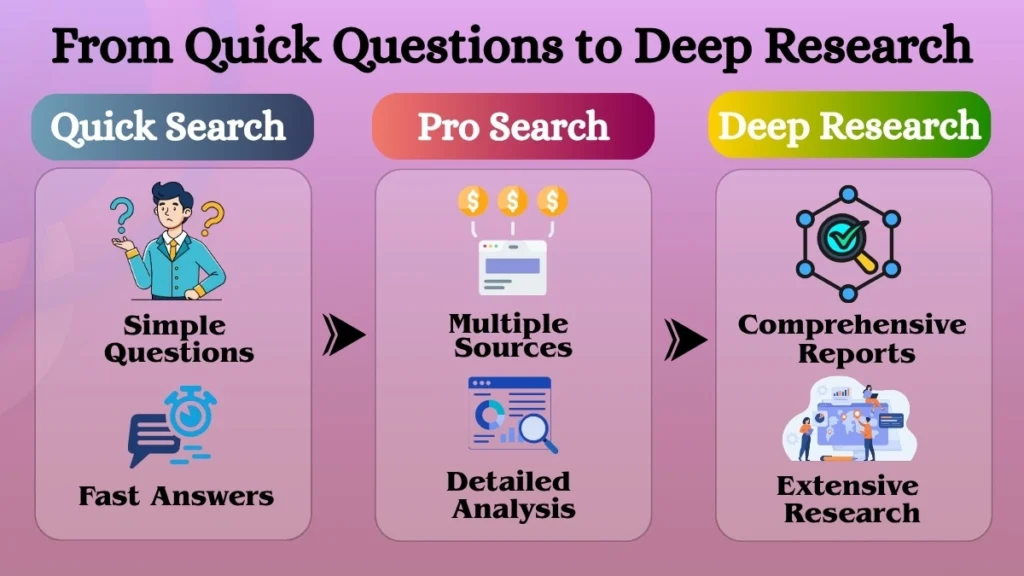
Quick Search for Everyday Questions
For everyday questions, typing what you are looking for and getting a quick, more or less straightforward response with sources attached might be what you are looking for. This can be good for getting definitions, information on words or concepts you don’t quite understand, looking for a general overview of something, or even getting some quick information on something more recent. A new person learning about artificial intelligence might use Perplexity to ask for an explanation of a certain AI term and then follow along with the sources cited to get a more in-depth understanding.
Pro Search for More Complex Questions
Some questions require a bit more nuance to answer. Pro Search is meant for these types of questions. Instead of getting thrown into a deep end and getting lost, Pro Search can help break down your search and cross-reference multiple sources until it finds something relevant.
This can be useful for things like comparing technologies, doing research on specific fields of work, and getting more involved with your questions.
Deep Research for Larger Topics
For larger research projects, Perplexity also offers Deep Research. This feature is designed for questions that need multiple searches and a broader overview of the available information.
Instead of providing a brief answer, it can take more time to compile and organize the information into a more comprehensive report. It can be beneficial in scenarios where the topic has multiple interconnected facets that need to be reviewed together.
What Can You Actually Do With Perplexity?
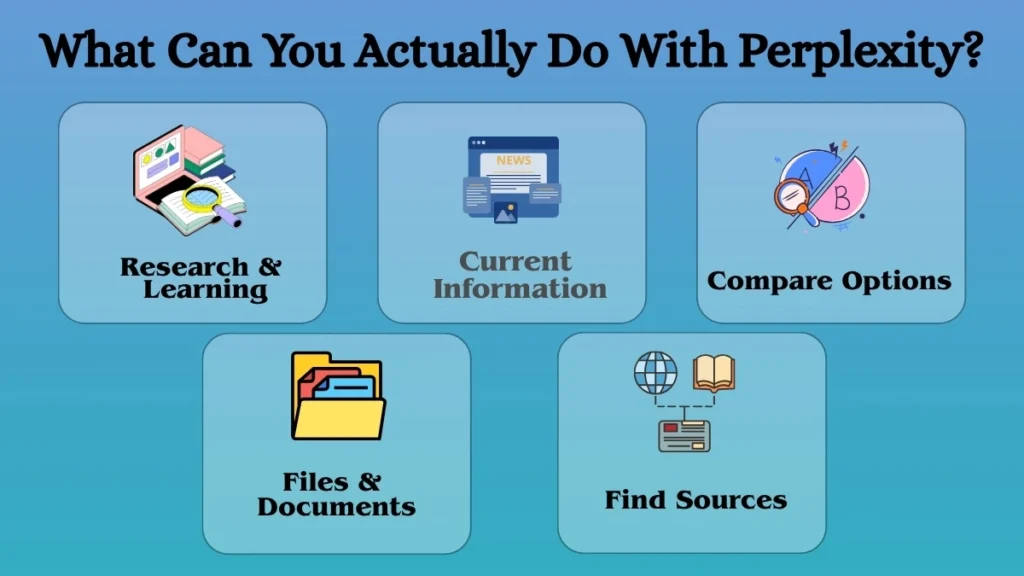
Research and Learning
Students can use Perplexity AI to understand unfamiliar subjects, clarify confusing concepts and even find relevant sources for further reading.
For example, a student studying cybersecurity could ask about phishing attacks, learn the basic concept, and then open the cited sources to expand on the topic. This is useful not only for getting an answer, but also as an entry point for learning.
Stay Updated With Current Information
Information on the internet is constantly changing. New products are released, software is updated, companies change their services and the technologies continue to develop.
Since Perplexity AI can search the web, it can also be used when you need information that may have changed recently. However, the date and credibility of the sources should ideally be reviewed, especially for time-sensitive topics.
Compare Products, Ideas, or Options
Perplexity AI can be used for comparisons as well. If you are faced with a number of options and want to understand their differences, you can ask Perplexity to compare them.
You can ask it to compare two smartphones, two programming tools, two software applications or two different approaches to a problem. It can review multiple sources and compile a list of notable differences for you.
Work With Files and Documents
Perplexity AI can also work with uploaded files. Instead of having to read an entire document from beginning to end, to find a particular detail, you can provide the file and ask questions about its contents.
Why Are Citations Such a Big Part of Perplexity?
Citations make an AI’s answer more transparent, allowing the user to easily fact-check its claims. Instead of taking an answer at face value, Perplexity AI gives you the ability to read the sources behind them.
This is especially valuable for research. If an answer incorporates a statistic or a certain statement, you can open the relevant source and read the context for yourself.
However, citations are not necessarily an indicator of an answer’s accuracy. A source can be taken out of context, the study can have methodological issues or simply be outdated. For this reason, it is important to read the original source for any critical information.
Perplexity AI vs Traditional Search Engines
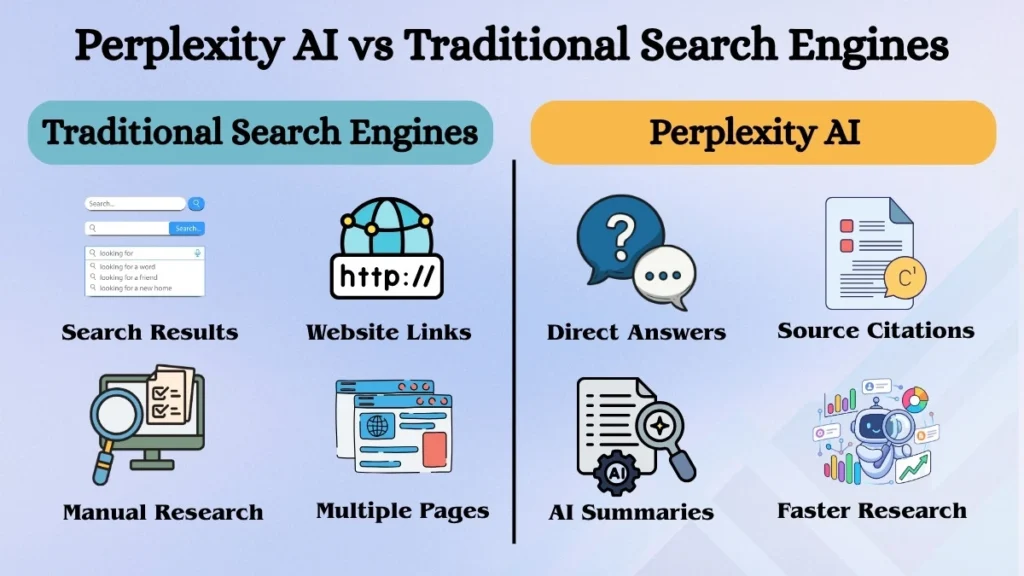
Traditional search engines are designed around the concept of finding webpages. One types in a query, receives search results, and proceeds to find relevant websites among the listings.
Meanwhile, Perplexity AI blends the search process with an AI-generated answer. Instead of receiving a list of relevant pages, a user instead gets a summarization of relevant bits of information.
It’s important to note neither method is superior under all circumstances. One might want to have a simple explanation while others might want to peruse through a list of websites. It’s all a matter of personal circumstance.
Perplexity AI Is Powerful, But It Isn’t Infallible
Perplexity AI can make research easier, but it’s by no means perfect. An AI can misunderstand a question, utilize faulty information, or outright provide an answer that doesn’t match what it said.
The reliability of the information can be affected by a number of factors as well, including how and what sources the AI has on-hand, and how well-worded the question is.
In regards to doing research for school, work, finances, and other serious fields, it’s better to be safe than sorry. Always take into account that what a search engine returns can vary significantly from one engine to the next, and fact-check whenever one is dealing with important information.
Who Can Benefit From Perplexity AI?
Anyone can benefit from Perplexity AI. From students, to writers, to professionals, to developers, and even to every average person out there looking for an answer to a question, Perplexity can be a valuable resource.
It can make researching easier, save time and effort, and allow one to find relevant sources faster. Whether it’s beneficial for you depends on the situation. If a user only wants to casually browse websites, then a traditional search engine might be better. But if user wants to find sources and answers faster, then an AI-driven answer engine has more utility in that case.
Where Is Perplexity AI Heading?
The realm of artificial intelligence searching is growing, and its reach no longer is limited to the mere act of searching for webpages. Perplexity, along with other alternative search engines, now are more focused on research, document analyzing and other more involved tasks.
The concept of searching will change in the future as these new tools emerge. One no longer will have to visit multiple webpages in order to find information. Instead, user can ask an AI to do that task for them, and then sift through the results afterwards. However, human supervision is still required for some searches, as an AI, for all its power, isn’t perfect.
Conclusion
Perplexity AI is a powerful tool that utilizes web searching, artificial intelligence, and citations to provide a more straightforward method of finding information. It can search, analyze, compile relevant information from various sources, and even work with uploaded documents and research materials to help users find relevant information more efficiently. It can be a valuable tool for students, professionals, writers, developers, and other average netizens who want a faster way of searching for information. However, it isn’t a perfect tool, and under certain conditions, a traditional search engine might have more utility. Even with proper citations, an AI can generate faulty or misleading information, and it’s always best to verify the sources user sees online.