
What Is ChatGPT and How Does It Work? Beginner-Friendly Guide
Introduction
It is highly likely that you have heard of ChatGPT if you are an internet user. The program can answer queries, explain details, compose emails, write code, summarize articles, and brainstorm ideas for you.
The main difference between ChatGPT and other online services is that you can have a control-like dialogue: you do not have to select an appropriate question from a set of suggested ones. Instead, you can write down what you wish the chatbot to do and ask more questions in the future.
However, if you write in normal language, how can a chatbot recognize what you want? How can it know what to say if you ask it to describe a certain topic? To address these questions, first, you need to know what ChatGPT is and what technology was used for its creation.
What Is ChatGPT?
ChatGPT is an AI chatbot created by OpenAI. ChatGPT’s main feature is that it understands human instructions and responds accordingly in a natural dialogue format.
Unlike many other chatbots, which relied on a set of frequently asked questions and answers, ChatGPT can answer any query. It indicates that you are not required to align your request with a certain instruction. To get the necessary information, you can type a question in natural language and wait for the response.
For instance, you can ask ChatGPT to describe a certain topic in simple words if you are a student. Alternatively, you can ask the bot to write an email instead of you if you are a busy professional. Both requests will yield different results.
How Does ChatGPT Work?
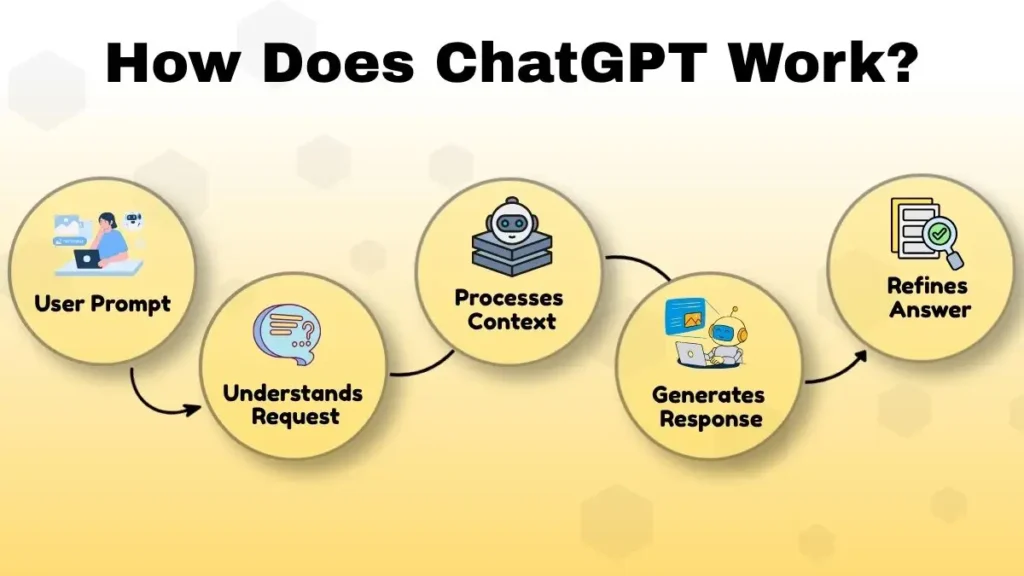
ChatGPT is a product of artificial intelligence.
The program uses applied AI to understand and generate natural language. The chatbot cross-references word patterns from training data to identify your request.
Therefore, it will not simply retrieve a response from a database, as some previous chatbots were able to do. Instead, you will have to compose a request in a certain way to get the desired output.
Overall, ChatGPT works similarly to any other language-modeling AI. It may be compared to a game in which you attempt to predict the following word. The program studies natural language patterns to come up with the most plausible answer. Consequently, you can get significantly different results when you change a prompt or add context.
What Is a Large Language Model (LLM)?
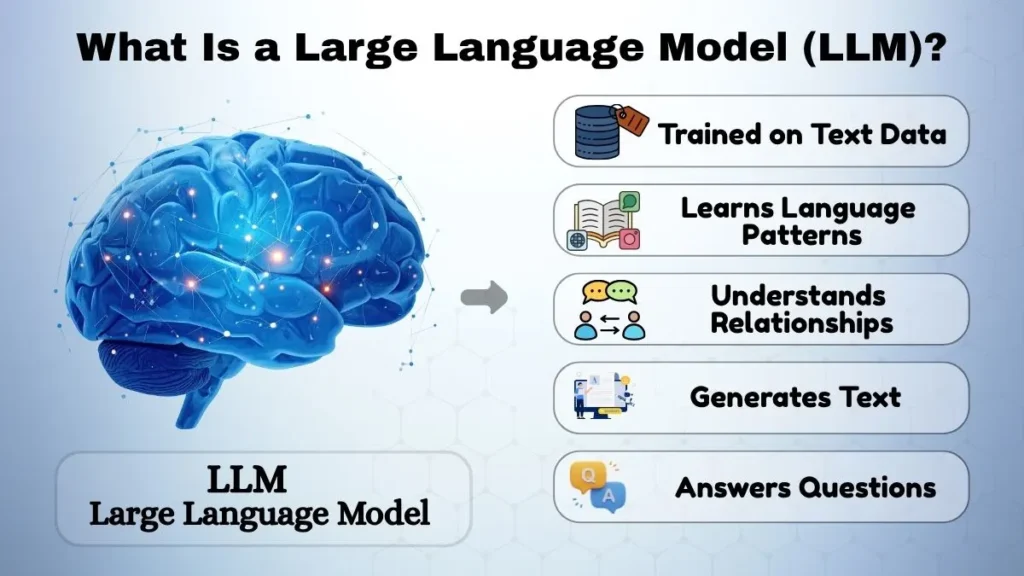
An AI model that utilizes human languages is called a large language model (LLM).
These models are trained using extensive text data, allowing them to learn language patterns and relations rather than memorizing individual responses.
As a result, it can perform various tasks, including answering questions, summarizing, rewriting, generating text, explaining information, and being helpful in many other language-related tasks.
ChatGPT uses large language models as its underlying technology, and the particular set of tasks it can perform may vary depending on the specific model and version. In general, the language model will attempt to combine and apply the information and patterns it has learned to produce an appropriate response to the user’s prompt.
What Can You Do With ChatGPT?
Using ChatGPT can be much more efficient than just asking questions. Some of the most common use cases include the following:
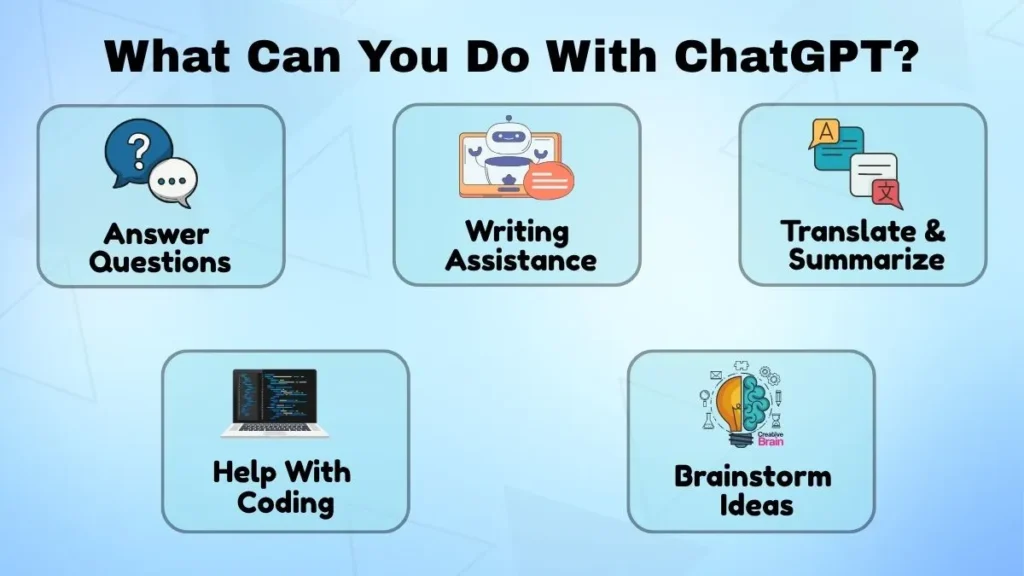
Asking Questions and Getting Answers
You can ask ChatGPT to explain the information to you in simple words, give examples, and clarify specific terms and concepts.
For instance, when a student reads a definition or explanation that they do not fully understand, they can simply ask ChatGPT to explain it like to a beginner instead of reading another complex definition.
Writing and Editing Assistance
ChatGPT can assist you with writing and editing. For instance, you can ask it for assistance writing an email, an article, a story, an announcement, or a social media post.
The same goes for rewriting and editing a text you have drafted. Note that you will likely need to review the rewritten text and make some edits yourself to ensure the results are as expected.
Help With Coding
ChatGPT can be a valuable tool while learning programming, since you can use it to
- Ask for an explanation of a certain piece of code
- Provide a solution for a programming issue
- Identify a possible mistake
- Give an example of a certain piece of code
or
- Request a simpler explanation of some ideas
Brainstorm and Plan
Sometimes, the hardest part about completing a task may be coming up with new ideas. Fortunately, you may ask ChatGPT to brainstorm some ideas for projects, presentations, study plans, content creation, among others.
Moreover, you may provide your own ideas and ask it to plan a feasible implementation of some or all of them.
Translate and Summarize Information
You may ask ChatGPT to translate some text into another language, or to summarize a certain text by removing all unnecessary information and providing the key points and ideas.
Such a skill may be especially helpful when you receive a lengthy article to read before studying. However, you should always double-check the information since the original content may be needed for some specific details.
What Distinguishes ChatGPT From a Search Engine?
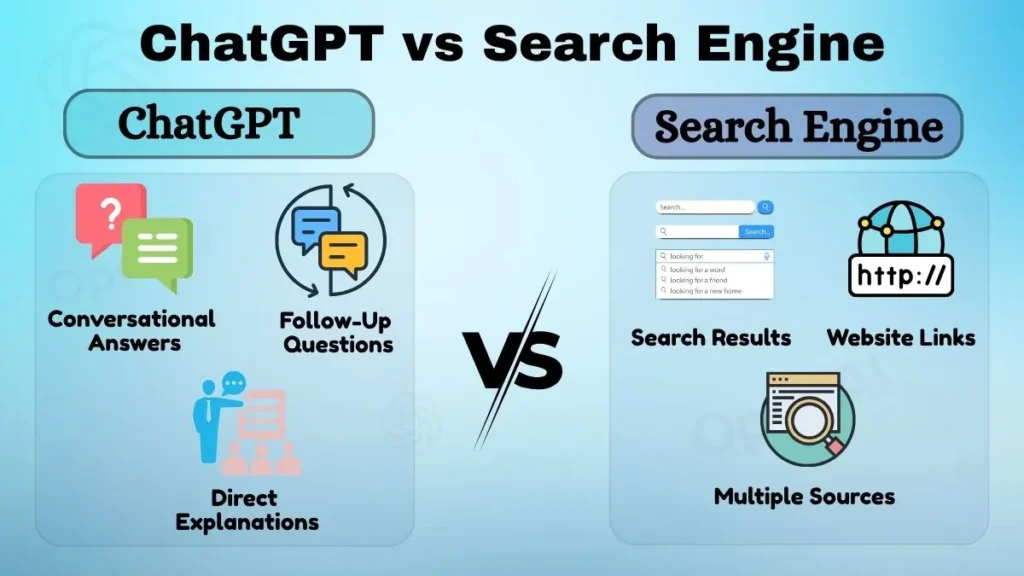
ChatGPT differs from a search engine in that both can help you find or learn information, but they do so in different ways.
A search engine is designed primarily to find web pages and other information, whereas ChatGPT is designed around the concept of a conversation. While the search engine will return results, you have to open a link to view the contents. With ChatGPT, instead, you can ask a question and receive a more conversational answer.
For instance, if you were to search “how does photosynthesis work?”, ChatGPT could provide you an explanation, instead of giving you a list of websites to visit. However, you can also use the conversation aspect of ChatGPT to ask follow-up questions like “explain like I am a complete beginner” or “give me an example”.
On the other hand, answers from AI are not always accurate, so it is important to verify especially critical information with an alternative, more reliable source.
What Are the Benefits of ChatGPT?
Probably the most important benefit of ChatGPT is the level of convenience it offers. You can ask for help with any number of tasks, without having to use multiple different tools for each unique task.
Some of the most common uses for ChatGPT are listed below:
- Fast assistance with questions and general tasks
- Getting difficult concepts explained to you in a simple way
- Help with editing and writing
- Learning to code
- Brainstorming and planning
- Asking for follow-up questions
- Being able to ask things in a conversational way
Being able to go back and ask another question in the same context without having to re-explain the background information is one of the most common benefits of a conversation-based interface.
What Are the Limitations of ChatGPT?
While it is possible to receive accurate information via the ChatGPT platform, the service may provide users with incorrect data. More specifically, one may find responses that mix correct and wrong information, and responses that sound convincing but include serious errors.
Furthermore, one might get a wrong answer if the question was phrased unclearly or if there was not enough context provided. Giving clear instructions will lead to better results, but it does not guarantee that they will be flawless.
It is crucial to consult reliable and credible sources before believing any information offered by an AI-driven service.
Moreover, one should refrain from sending sensitive or confidential information via this platform or any other AI service if one is not certain about the security measures employed by the service.
Is ChatGPT Free to Use?
There are both free and premium subscriptions for ChatGPT.
Since the plans and tools change constantly, everyone who subscribes to the service will have a different experience. It is advisable to check the most recent information about ChatGPT’s plans and choose the one that best suits one’s needs.
What Is the Future of ChatGPT?
Chatbots such as ChatGPT can be utilized in various spheres of one’s life, including:
- Education
- Coding
- Learning
- Writing
- Searching for information
- Working
- Making plans
The future of AI is bright as these systems become smarter and more advanced over time. They can be used in different settings including educational or professional, to complete more complicated tasks. Furthermore, these systems can be linked to other programs and operate as an integral part of an individual’s digital workspace.
However, one should remember that with greater power comes greater responsibility. While one can benefit massively from the capabilities granted by AI systems, one should not rely on one’s digital assistant for critical information or decisions.
Conclusion
ChatGPT is an AI chatbot that utilizes large language models to simulate a conversation with a human. It can be used for learning, writing, coding, thinking, brainstorming, researching, and a multitude of other daily tasks.
The system works in a unique way when compared to a search engine because users can double-check the information, ask follow-up questions, and fine-tune their requests. While it is an invaluable tool that can assist humans in completing everyday tasks, it is an unreliable source of information because it often gives incorrect data and response instructions. Understanding the limitations and possibilities of an AI-driven chatbot is essential to getting the most out of them.