
What Are the Advantages and Disadvantages of AI?
Introduction
Artificial intelligence is now widely used in everyday life. Artificial intelligence is used for learning, writing, researching, and performing routine activities.
However, artificial intelligence is not always applicable in all circumstances. A technology that helps in saving time may also make people over-reliant on it. Technology that gives quick answers may give wrong information. Technology that provides convenience may create issues regarding privacy.
This is the reason why it is necessary to look at the two aspects of AI. Knowing the advantages of AI helps people understand where AI can be useful, while knowing the weaknesses makes one capable of seeing any issues that may arise.
In this article, we will try to analyze the most significant advantages and disadvantages of AI through the use of some examples that will help to better understand the ideas expressed.
What Are the Advantages of AI?
Several practical advantages of AI can be gained in education, business, general technology, and various other fields.
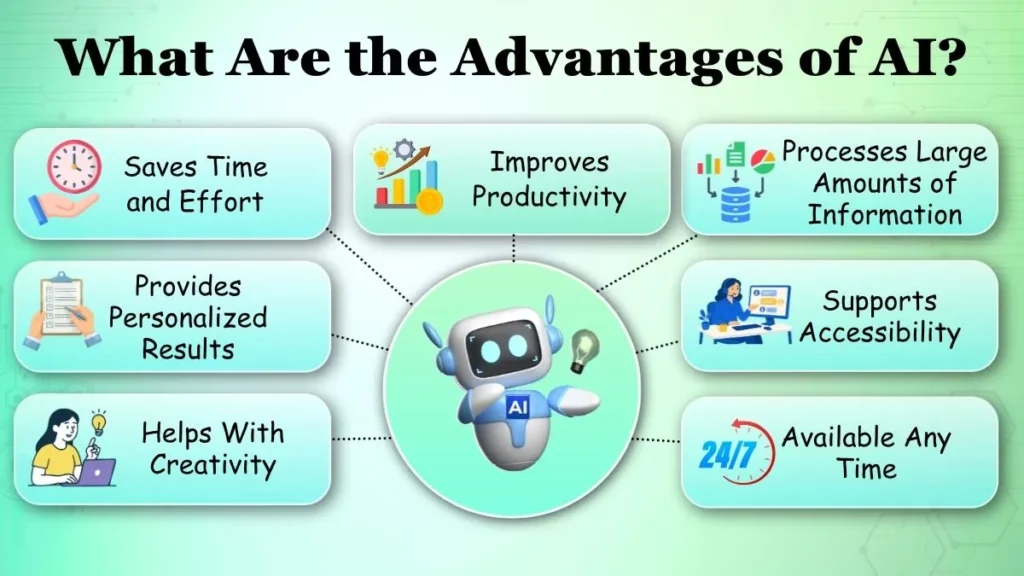
Saves Time and Effort
Firstly, Advantages of AI is that it helps to automate routine processes.
For instance, a firm may receive hundreds of similar queries from its customers each day. An AI chatbot will handle simple ones, and humans can concentrate on those requiring human intervention.
Also, AI can help to process documents, organize data, or even write first drafts. Thus, users can focus their attention on other activities.
Improves Productivity
The advantages of AI include that it can assist people in using their time during work productively.
The student can utilize AI to convert lengthy notes into an easy-to-understand study outline. The employee can use AI to structure his thoughts for drafting the report.
AI can take away the burden of preparation while people carry out reviewing and decision-making.
Processes Large Amounts of Information
Certain jobs require analyzing more data than any individual could handle manually.
Artificial intelligence can process bulk data and help uncover information that should be focused on. Such a method can be used in science, business, financial services, medicine, and many other industries dealing with lots of information.
For example, a company with several customer accounts can use artificial intelligence to find some buying patterns among customers. Then, people can analyze these results and make conclusions from them.
Provides Personalized Results
AI can be used for personalizing digital offerings to individual users, which is one of the key advantages of AI.
An online store could suggest goods according to user’s search history or previous purchases. A video streaming platform could suggest videos, films, and music according to users actions.
Personalization can also work for educational purposes. A learning platform could recommend resources according to student’s progress and interests.
It would make the service more relevant.
Supports Accessibility
The use of AI can give individuals alternative means to interact with technology.
Speech recognition technology can translate spoken words into texts. Text to speech technology can narrate written words. Language translation tools can assist in communicating across different languages.
A person that finds it hard to type can use voice recognition as an alternative means of using technology.
Helps With Creativity and Ideas
AI is helpful where there is need for a starting point.
A student will request ideas for his or her presentation from an AI. An author will try out various ways to approach a certain issue. An artist will try out several concepts before settling on one idea.
The AI provides ideas but the person chooses which way to go.
Available at Any Time
A number of AI-driven applications offer assistance beyond regular business hours.
One such example for advantages of AI would be an online business using an AI chatbot to respond to customer queries after hours.
This would be particularly useful if employees are not available, but some complex queries might require human assistance.
What Are the Disadvantages of AI?
AI presents problems in relation to accuracy, privacy, employment, dependency, misuse, and cost. Some Disadvantages of AI is follow:
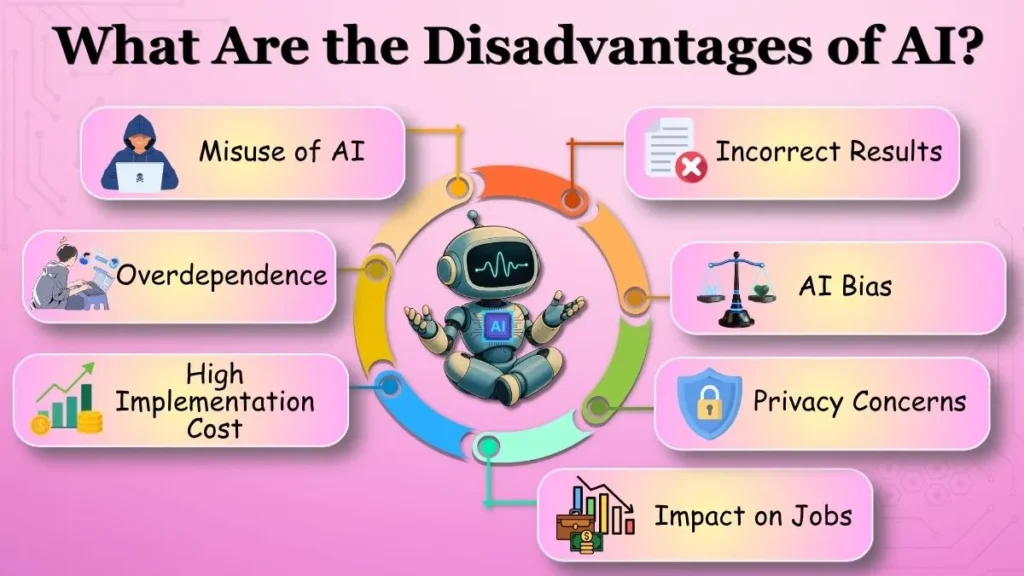
AI Can Produce Incorrect Results
Disadvantages of AI is that it can present information which is not accurate, complete, or truthful.
The incorrect response will be presented with certainty.
Consider a scenario where a student requests information from an AI system for an assignment. If the information provided is incorrect and is not verified by the student, the error will end up on the assignment.
For critical information, verification from a trustworthy source must be done for AI outputs.
Privacy and Data Concerns
Privacy issues may arise because some AI systems handle information provided by users.
This is important especially in cases where confidential or personal information is submitted.
For example, an employee can submit a company document to the AI service in order to obtain an instant summary of the document. However, before submitting the document, it is important for the employee to be familiar with how the system uses the user’s data.
AI Can Show Bias
AI does not guarantee neutral outputs automatically.
The data set used in developing an AI algorithm is biased on its own. In addition to the data sets, there can be design issues too.
If the issue is not handled appropriately, the output will be biased or unbalanced. There are chances that human evaluation will discover issues which will not be identified by automated methods.
Job Roles Can Be Affected
The use of AI may automate some activities which people used to do manually.
As an illustration, a firm may deploy AI for answering simple queries from customers. The employees would consequently get enough time to tackle complicated problems rather than spending time on routine ones.
This is not to say that jobs will all vanish. Many times, it is the roles involved in the job that may change.
Overdependence on AI
Efficiency of a certain tool may be turned into a problem when people depend on it too much.
Just think about a case where a student asks AI to solve all homework problems rather than learn the material of the lesson. In such a case, the student may have more time to complete the assignment, but the practice of solving problems will be missing.
This situation can happen with employees who take artificial intelligence’s work for granted.
AI is meant to assist, not to replace humans.
AI Can Be Misused
AI has the potential to provide valuable material, but it may also be abused.
It can help in the creation of misleading content, fake images, manipulated videos, acts of impersonation, and even scam content.
Scammers can create a believable message which seems to have originated from a person whom the victim knows.
The realism of AI generated content requires one to be careful when sharing and believing such content online.
AI Can Be Costly to Implement
The use of AI software by a single person might be straightforward, however the development of complex AI technology may require huge costs.
These include hardware, software, people, training, security, and maintenance.
For a small company, this may prove to be too difficult to implement due to high costs.
In other words, while AI can help cut down costs in certain cases, it can also experience costs for the organization.
Advantages and Disadvantages of AI at a Glance
|
Advantages |
Disadvantages |
|---|---|
|
Increased convenience |
Increased risks of errors |
|
Reduced physical work |
Reduced opportunities for independent thought |
|
Quick access to help |
Increased privacy issues |
|
Customization opportunities |
Unfair outcomes are possible |
|
Better accessibility |
Changing work requirements |
|
Increased creativity possibilities |
Higher risks of abuse |
|
Reduction of effort in certain tasks |
Implementation costs are higher |
The above comparison makes it clear that both the advantages of AI and its disadvantages deserve careful consideration.
How Should AI Be Used?
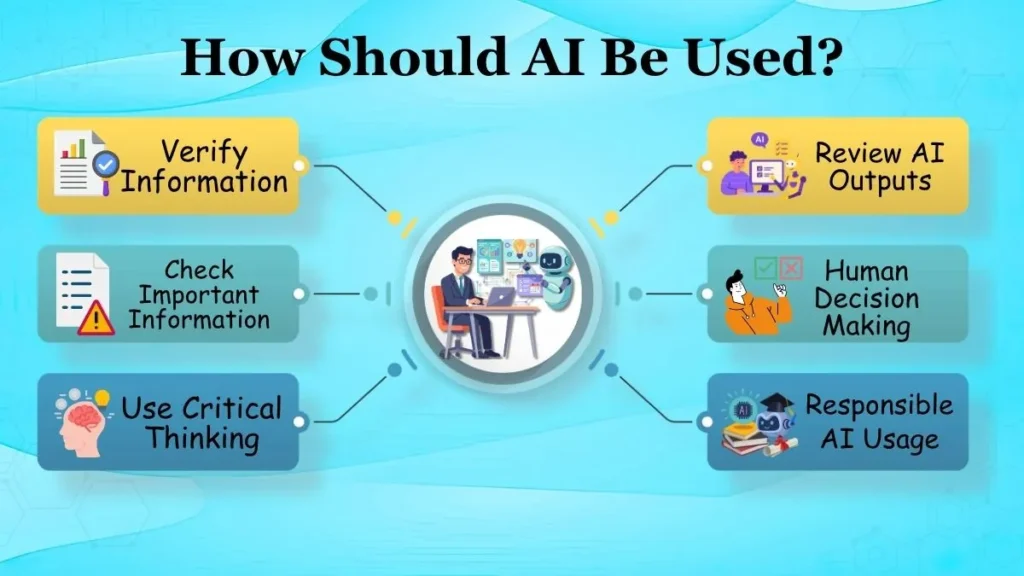
There is no need for AI to do everything, but there is no need for it to avoid doing everything either.
Important information must always be checked before accepting it as factual. Sensitive or confidential information must be handled accordingly. Similarly, AI-produced content must also be checked before submission, publication, or making any crucial decisions.
AI can be used by students to comprehend hard concepts or structure their ideas. It can also be used by professionals to complete routine work and draft initial versions of texts.
AI can be applied where it makes sense, with the human element in control.
Conclusion
The several advantages of AI make a valuable technology in everyday life. This includes helping to eliminate redundancy, increasing efficiency, processing huge amounts of data, providing personalized output, facilitating accessibility, assisting with brainstorming, and offering help at different times.
On the other hand, there are also some serious drawbacks associated with the use of AI. This includes providing inaccurate information, posing privacy risks, exhibiting biases, impacting jobs, encouraging dependence, being abused, and demanding heavy investments.
The growing advantages of AI explain its increasing usefulness, while its drawbacks show why AI output should not be accepted without thought.
When people understand both sides of AI and use it carefully, they can gain its benefits while reducing unnecessary risks.
Next in the series: What Is Generative AI and How Does It Work?