
Types of Computers and Their Uses
Introduction
When it comes to using a computer, every user does not have the same requirements. People use computers for various purposes, like studying and learning, while others may use them for office work, entertainment, professional projects, or to manage tasks in organizations. Since computers are used for different purposes, a single type of device cannot meet every user’s needs. To solve this, computers are available in different types, each designed for a specific use.
Understanding the purpose of each type of computer helps beginners make practical and informed choices. This article is written especially for beginners to understand different types of computers and their practical applications. It further explains the major types of computers and their uses in a simple and easy-to-understand manner, without any technical comparisons, specifications, or complicated differences.
Classification of Computers (Basic Overview Only)
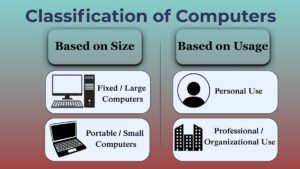
Computers are classified in several ways, but at the beginner level, it is enough to understand a basic overview. In simple terms, computers are commonly classified based on size and usage. This basic classification helps learners understand why multiple computers exist, where they are generally used, and why they are different from each other.
Classification Based on Size
Some computers are larger in size and are generally designed to be used at a fixed place, while others are smaller and easier to carry. The size of a computer often decides how convenient it is, how portable it is, and where it is mostly used. For example, a computer that is placed on a particular desk is suitable for a fixed workspace, whereas smaller devices are useful for people who want to work from different locations. In general, larger computers are used in stable environments, whereas smaller computers support mobility and quick access.
Classification Based on Usage
Computers are also classified based on what purpose they are mainly used for. Some computers are designed for personal uses such as home-related work, study, and daily activities. While others are designed for professional or organizational usage where the work may include multiple users or large-scale work. These classifications help beginners to understand that computers are not only personal devices. Many computers are also used behind the scenes in offices, and organizations to support daily operations.
Desktop Computers
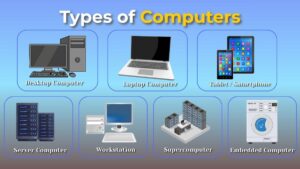
A computer that is generally used at a fixed location is known as a desktop computer. It is designed to be stable at one place, not to move frequently at different locations. Once the setup is completed, it usually remains in one place and is used regularly.
Common Uses of Desktop Computers
Desktop computers are widely used because they are perfect for regular work routines. They are very commonly used in houses, schools, and offices, especially where users require a stable setup for longer working hours. Many people prefer desktop computers for continuous and focused work, as they are used to being in a comfortable and organized environment.
Laptop Computers
Computers that are portable and can be easily carried to different locations are known as laptops. This type of computer is designed for users who want flexibility and mobility. Unlike desktop computers, laptops are not limited to a fixed place or location and can be used in different environments.
The main difference between laptops and desktop computers is not about complex technical points, but it is about usability. Since laptops are portable, they make users capable of working from multiple locations such as at home, in classrooms, offices, or while traveling. This ability makes them very useful for people like learners and professionals who prefer a flexible working style.
Tablet and Smartphone as Computers
Tablets and smartphones are small, touch-based devices that can perform many computer-related tasks. Although they are not the same as traditional computers, they still help users perform basic computing tasks. These devices have become very common because they are simple to use, lightweight, and convenient. Many people use tablets and smartphones for their daily life activities such as studying, communicating, and for online activities. In fact, these devices have become the main tool for some people to use the internet and do basic digital tasks.
These devices are widely used for browsing the internet, and accessing online services. People can get quick access to knowledge and online services by using these devices. As modern computing devices, tablets and smartphones are widely used for everyday digital activities.
Workstation Computers
Workstation computers are used for professional design work such as creating high-level designs, digital creative projects, and design-based tasks. They help professionals work efficiently in design-related fields. Workstations are also used for technical and engineering-related tasks. They support tasks that require detailed and high-level professional work.
Researchers may use workstation computers for analysis, academic work, and research activities. These computers help professionals in managing study-related work in a reliable and productive way.
Server Computers
Server computers are used for providing services to multiple users at the same time. Unlike personal computers, servers are not meant for individual or personal work like entertainment or studying. They act as a central system that supports users and multiple systems in an organized manner.
Servers are very important for workplaces and institutions, as they help in managing shared information. They provide access to multiple services. Many digital services used in daily life depend on servers to function smoothly.
Supercomputers
Supercomputers are extremely powerful computers. They are designed for special and large-scale work purposes. They are not used for daily tasks but for advanced research and complex problem-solving.
They are usually used by research centers, scientific institutions, and specialized organizations. Their work involves solving problems that require large-scale analysis and advanced processing, such as scientific research and weather forecasting.
Embedded Computers
Embedded computers are computers built inside machines and devices. They work quietly in the background and perform specific tasks automatically. Many people use embedded computers in daily life without realizing that a computer is operating inside the device.
Embedded computers are designed to control specific functions and improve machine performance. They help devices operate smoothly, efficiently, and with better control. Everyday examples of embedded computers are washing machines, cars, and smart appliances.
Choosing the Right Type of Computer
Choosing the right option from the different types of computers depends on the purpose for which it is needed. Beginners should focus on their actual requirements rather than getting confused by unnecessary details. A practical choice should always be based on how and where the computer will be used. It is a good idea to first decide whether your use is personal or professional. This makes the selection process simpler and more meaningful.
Conclusion
Different types of computers are designed to meet various needs. Every type of computer serves a specific purpose. Any single device is not suitable for every task. Some computers are meant for daily activities, while others are designed for professional work.
Understanding these computer categories helps beginners choose the right device according to their needs. This knowledge will also build a strong foundation and make computer usage more practical, easier, and more effective in real life.