
History and Evolution of Computers Explained – A Beginner Guide to 5 Generations
Introduction
The history and evolution of computers explain how they became an important part of daily life. In the beginning, computers were not as capable as modern computers. Initially, they were created only for simple tasks like calculations. The advanced computers that we use today are the result of many years of human thinking, inventions, and continuous technological development.
By studying the history and evolution of computers, beginners can clearly understand how early calculating tools developed into modern digital machines. This will help readers understand the functioning and design of current computers. It also creates a strong foundation for understanding advanced computer concepts later.
Early Computing Before Modern Computers
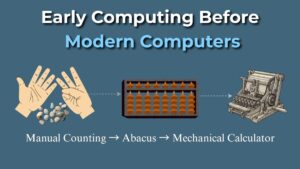
In the early days, before the invention of modern technology and computers, people used to perform calculations manually. They were dependent on various objects like fingers, stones, symbols, and written marks to solve mathematical problems. As societies grew and became more complex in terms of population and administration, these manual methods felt slow, difficult, and more prone to mistakes. With the expansion of trade, science, and administrative work, the requirement for faster and more efficient calculation methods increased. This growing demand led to the development of early computing tools that could support humans in performing calculations more easily and efficiently.
The increasing requirement for speed and accuracy in calculations encouraged the invention of early mechanical computing tools. These computing machines were created and designed to help humans perform calculations more efficiently and reliably. Rather than depending completely on manual efforts, people started using tools that could handle calculations in a more systematic and organized manner.
First Mechanical Computing Devices
Abacus
An abacus is one of the oldest calculating instruments used by humans. It was made of beads that would slide along rods and help in performing arithmetic operations such as addition, subtraction, multiplication, and division. Although the abacus was a simple device, it introduced a structured method of calculation and helped people solve mathematical problems faster than manual counting.
Early Mechanical Calculators
After the invention of the abacus, more advanced computing calculators were created and designed to further reduce manual efforts in calculations. These were designed using components such as gears, wheels, and levers, which helped to carry out arithmetic operations.
These machines increased accuracy and were especially useful in business and scientific fields. Mechanical calculators proved that machines are capable of performing complex calculations efficiently and reliably.
Key Inventors in Computer History
Charles Babbage
Charles Babbage is known as the “Father of the Computer” because of his major contributions to computing. The Analytical Engine, a mechanical device, was designed by Charles Babbage. Although this machine could not be fully completed during his lifetime, its design included major ideas such as input, processing, storage, and output. These ideas were so brilliant that they are even used in modern computers, showing the lasting impact of Babbage’s work.
Ada Lovelace
The first computer programmer in history is Ada Lovelace, who worked alongside Charles Babbage. She was the one who wrote detailed instructions for the Analytical Engine and also the one who understood that the machine could be used for more than just mathematical calculations. Modern programming concepts were introduced through her ideas, which later became a fundamental part of science and digital computing.
Evolution of Computers by Generations
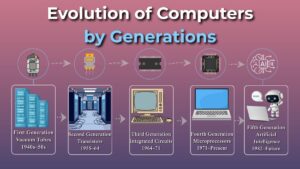
The history and evolution of computers is best understood by studying different computer generations, as each generation represents a major technological improvement, which enhanced computer speed, reduced size, improved efficiency, and increased ease of use. Understanding all the generations clearly shows how computers progressed gradually into the advanced systems that we use today.
First-Generation Computers
The first generation of computers was created during the 1940s and 1950s, which was based on vacuum tube technology. These machines were extremely large in size, consumed a large amount of electricity, and produced excessive heat. They were used mainly for scientific research and military purposes. They had a few limitations, but even with those drawbacks, these computers proved that electronic machines could successfully perform complex calculations.
Second-Generation Computers
The second generation of computers was created between 1955 and 1964. They replaced vacuum tubes with transistors. This enhancement made computers smaller, faster, and more reliable. They started consuming less power and producing much less heat compared to first-generation computers. These systems were mainly used in universities, research centers, and early commercial applications.
Third-Generation Computers
The third generation of computers was created between 1964 and 1971. They introduced integrated circuits, which allowed multiple transistors to be placed on a single chip. This improvement reduced the size of computers greatly while enhancing their speed and overall performance. In the third generation period, computers became more affordable and also began to be widely used by businesses for multiple tasks such as data processing and record-keeping.
Fourth-Generation Computers
The creation of fourth-generation computers was initiated around 1971. They introduced microprocessors that made it possible to place an entire processing unit on a single chip. This made computers much smaller in size, and this improvement also led to the creation of personal computers. The impact of this improvement is clearly visible in the modern era. Computers became easily available for homes, schools, and offices, transforming them into everyday tools rather than devices used only by large organizations.
Fifth-Generation Computers
The fifth generation of computers was conceptualized and launched with Japan’s major initiative in 1982. They focus on advanced and emerging technologies such as AI (artificial intelligence) and automation. These computers are designed to manage complex tasks, process large amounts of data, and help humans intelligently. This generation of computers is the one that we are using now, and they are still developing. They represent the future vision of computer technology.
How Computers Evolved in Daily Life
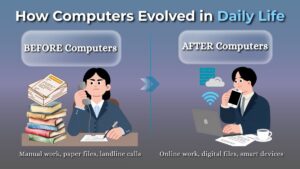
With the evolution of computers, they became smaller in size, better in performance, faster in operation, and much more affordable for users. Initial computers needed large rooms, while modern computers are portable and compact. The processing speed of computers improved significantly. With time, they became easier to operate. This progress allowed computers to transform from limited large professional use to an essential tool in daily activities such as education, communication, business, and entertainment.
Conclusion
The journey of the computer, which started as a simple counting device and evolved into a powerful digital machine, is truly commendable. Each and every stage of development introduced new ideas that enhanced speed, efficiency, and ease of use. Understanding this journey helps beginners build a strong foundation for learning modern and future computing technologies.