
Analog, Digital and Hybrid Computers Explained
Introduction
We use the word “computer” for many devices, but not all of them work in the same way. Different computers use different methods to handle data and produce results. Some computers work with continuously changing values, some work with specific numbers and symbols, and some combine both approaches. Because of these different working methods, computers are commonly grouped into three main types based on how they process the data:
- Analog computers
- Digital computers
- Hybrid computers
Each type is designed for a different kind of task. For example, measurement-based devices often require continuous values, while everyday tasks need clear and accurate results.
Understanding these three basic types of computers is very important for beginners. It will help you build a strong foundation and remove any confusion when you hear such terms in studies, exams, or real-life situations. This article will explain analog, digital, and hybrid computers to you in a simple and non-technical manner, without any deep theory, complex formulas, or any difficult technical diagrams.
What Are Analog Computers?
A computer that works with continuous values, instead of exact numbers, is known as an analog computer. Here “continuous” means the value of data can smoothly change over time without stopping at fixed steps.
In easy words, analog computers focus more on measuring physical changes rather than calculating digits. They work with quantities in the real world like temperature, speed, or time, because such values keep changing. Analog computers usually generate approximate results instead of perfectly exact answers.
Providing approximate results does not mean that analog computers are “wrong” or “useless”. Approximate results are completely acceptable for many real-life cases. For example, when a driver checks the vehicle speed while driving, they only need a close and practical reading, not an exact long decimal value.
Analog computers are mainly used where continuous measurement is more important than exact calculation.
How Do Analog Computers Work (Basic Idea)
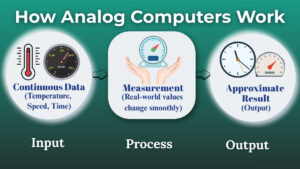
Analog computers work using continuous signals. A signal simply means a changing value or data that represents a real-life situation. For example:
- Rising temperature is represented by a smoothly increasing reading.
- Vehicle speed is represented by a moving pointer in the speedometer.
- Time is represented by hands moving around the clock.
Rather than converting information into digits, analog systems display changes in a direct way. Since the data is continuous in nature, the output is usually an approximation or an estimate, not a perfectly exact value.
This method of functioning makes analog computers useful for measurement-based situations, where quick understanding matters more than exact outcomes.
Common Examples of Analog Computers
Analog computers can be easily found around us in daily life. A few common examples are:
- Thermometer: It shows body temperature changes based on a continuous scale.
- Speedometer: It shows the vehicle changing speed using a moving needle or pointer.
- Analog clock: It shows time using hands that move smoothly.
The above-mentioned devices represent values through physical movements or continuous change. They may not seem like computers in the modern sense, but they conceptually perform computing-like work by handling and showing continuous data.
What Are Digital Computers?
The most common type of computer used today is the digital computer. It works with discrete data, which means processing information in separate steps instead of a continuous flow.
Digital computers handle the data in the form of:
- Numbers.
- Symbols.
- Letters.
- Stored data.
Digital computers generate accurate and precise results, unlike analog computers. Because they process data in a systematic and controlled way, this is the reason why they are widely used in homes, schools, offices, and businesses.
From writing simple documents to browsing the internet, most of the daily life tasks are now dependent on digital computers.
How Digital Computers Work (Simple Explanation)
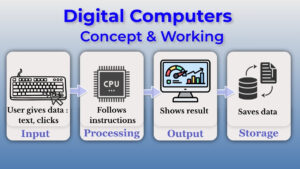
Digital computers work by following a basic pattern:
- They accept input in a digital form given by the user (such as text typed, clicks, or selected options).
- Then they process the data according to given instructions.
- Next, they produce output in a readable form (like text, images, or results).
- Lastly, they store the data for later use.
Information is processed in a fixed pattern in digital computers. Even if the user uploads a photo, writes a message, or plays a video, the computer converts the information and handles everything as digital data.
The main advantage of digital computers is that they follow instructions clearly, which makes the output:
- Repeatable.
- Accurate.
- Reliable.
These capabilities are the major reason why digital computers dominate daily life.
Examples of Digital Computers
Some common examples of digital computers include:
- Desktop computers
- Laptop computers
- Smartphones
These devices are widely used for daily tasks such as:
- Studying and understanding concepts
- Communicating online
- Creating documents
- Website browsing
- Watching videos and listening to music
Digital computers are the most familiar and widely used type of computer in the modern world.
What Are Hybrid Computers?
A system that combines both the features of analog and digital computers is known as a hybrid computer. In simple words, it uses:
- For continuous input or measurement, it uses analog methods
- For accurate processing and output, it uses digital methods
Hybrid computers are used in special situations where both continuous measurement and accurate results are required. Their purpose is mostly professional or specialized, which is why they are not commonly used by general users. They are designed to handle tasks where real-time data collection is necessary, but the final output should still be accurate and clearly processed.
How Do Hybrid Computers Work
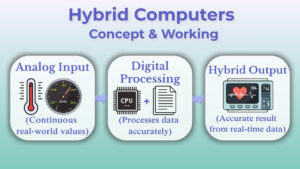
Hybrid computers work in a combined way of both analog and digital:
- Firstly, they accept analog input. For example, physical measurements that change continuously.
- In the next step, they use digital processing to convert the given information into accurate and meaningful results.
Two major benefits that this approach gives to hybrid computers are:
- Fast and proper handling of real-world changing data.
- Output generated after processing is reliable and accurate.
These abilities make hybrid computers suitable for environments where both speed and accuracy matter.
Examples of Hybrid Computers in Real-Life
They are mainly found in professional and technical systems.
A few real-life examples are:
- Medical equipment used for patient monitoring: These systems are used to continuously measure body related values and provide exact readings.
- Scientific systems used for research and testing: These systems collect real-time data and process it into meaningful results for analysis.
Hybrid computers are specially designed for tasks where both continuous input and accurate processing are required.
Key Differences Between Analog, Digital, and Hybrid Computers
If we conceptually understand the differences between these three types, then it will become easier to compare them. Any technical details are not needed to separate them clearly.
Data Type Used
- Analog computers use continuously changing data.
- Digital computers use discrete data such as numbers, symbols, and step-by-step information.
- Hybrid computers use both continuous and discrete data.
- The data type used by the systems decides how the computer works and where it is useful.
Accuracy Level
- Analog computers usually give estimated results.
- Digital computers provide precise and accurate results.
- Hybrid computers aim to provide accurate results while handling real-time continuous data.
These differences are the reason why digital computers are mainly preferred for tasks that require correctness and accurate output.
Common Usage
- Analog computers are mainly used for measurement-based tasks.
- Digital computers are mainly used for daily activities.
- Hybrid computers are used in professional environments for special-purpose systems.
Conclusion
Computers differ based on how they handle and process data. They are mainly divided into three types: analog, digital, and hybrid computers.
Each of them is known for its capabilities. Nowadays, digital computers are very commonly used in daily life. Meanwhile, hybrid computers also play an important role in medical and scientific environments. Understanding the types of computers and their purposes helps to create a strong foundation for further advanced computer knowledge.