
Limitations of Computers Explained for Beginners
Introduction
In today’s modern era, computers are considered a powerful tool. They are useful for almost every task. They help us in various fields such as education, business, communication, and day to day activities. They can handle multiple tasks, from managing records to performing calculations and accessing information through the internet. Computers have become a necessity for our daily lives. However, even though computers are fast and accurate, they are not perfect.
Any tool or machine has certain pros and cons. Like any other machine, a computer also has certain limitations. They are multitaskers and can perform many tasks efficiently, but there are some areas where they are still completely dependent on humans. Learning about those limitations is very important so that users keep their expectations in a particular limit, and not expect anything from computers beyond their ability.
Many people rely on computers heavily without realizing their limitations. This misunderstanding can sometimes lead to mistakes, loss of important data, or confusion. Understanding both the strengths and weaknesses of computers will avoid this misunderstanding and help users use computers wisely.
The main purpose of this article is to describe and explain the real limitations of computers in a simple and understandable language. Learning about these limitations will help beginners to develop a balanced and realistic view of computer usage. It will also help them to use technology more effectively and practically.
What Are Limitations of a Computer?
Before learning about the limitations of a computer, let us understand the meaning of limitations. Limitations refer to the restrictions or weaknesses which prevent something from performing certain particular tasks independently.
In the case of computers, limitations point out to the tasks they cannot perform on their own or the situations where they are dependent on human input and continuous supervision. These limitations describe that even though computers are powerful, still they are not completely independent systems.
Learning about limitations will help beginners to know when human involvement is necessary. It will also remind users that computers are machines created to assist humans, not to replace them.
Meaning of Limitations
Limitations are the tasks or activities that a computer cannot complete on its own.
From the previous articles, you all might have already understood that a computer works only according to the instructions given by the user. If a computer is not programmed or guided properly, it will not be able to act or respond correctly. All these reasons make it clear that computers are always dependent on human involvement.
Major Limitations of Computers
In this section, you will understand the main limitations of computer that every beginner should know.
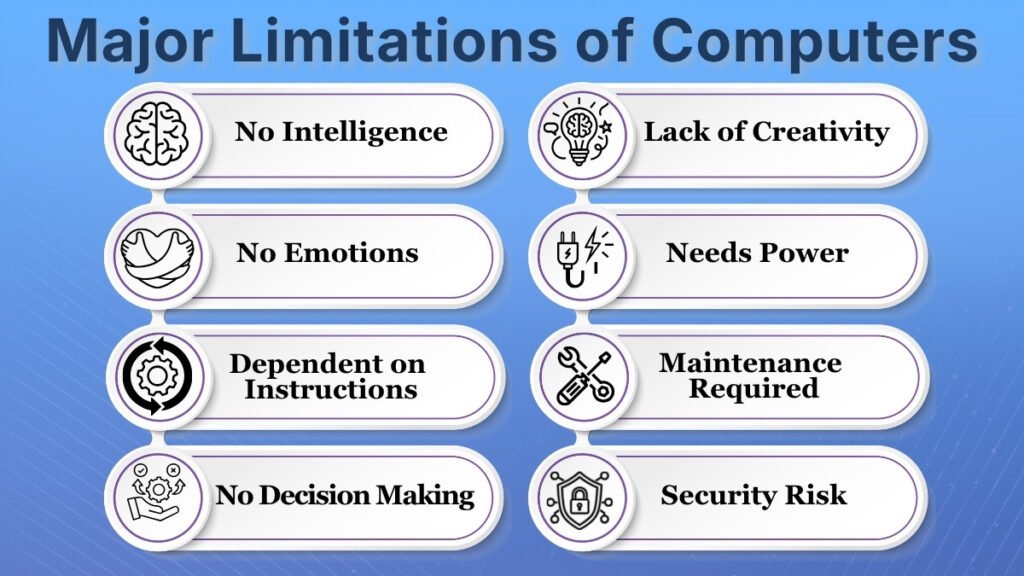
No Intelligence or Thinking Ability
Unlike humans, a computer does not have any natural intelligence. It cannot think, feel, understand, or analyze situations like a human being does.
It just follows the instructions and predefined programs given to it. If any task is not programmed, the computer will not be able to perform it independently. It cannot use common sense or adapt to new situations without guidance or instructions.
These limitations show how computers are just instruction-based machines and not thinking beings. Unlike humans, they cannot learn from prior experience on their own unless guided properly.
No Emotions or Feelings
Computers do not have emotions or feelings. They cannot understand or express emotions such as happiness, sadness, anger, or empathy like humans do.
Because of this, they cannot make decisions that are based on feelings. They also cannot respond to emotional situations. Computers are limited in areas where human understanding and emotional sensitivity are required.
Computers are unable to have emotional intelligence. Because of this major reason, computers cannot replace humans in the positions where emotional connection is required such as counselling, personal interaction, teaching, politics etc.
Dependent on Instructions
As we saw earlier, computers are completely dependent on instructions and input provided by the user.
If instructions are given correctly, then the output will also be correct. If the input is incorrect, then the result will also be incorrect. This can be described as:
Wrong input leads to wrong output.
A computer cannot perform any meaningful task without instructions. It cannot take any initiative on its own. This is the root reason why users need to be careful while giving commands.
No Decision Making Ability
We have already learned that computers are unable to make independent decisions without human involvement. They cannot decide or judge whether something is right or wrong, unless they are provided with clear guidance and rules.
They simply work with the predefined programs and instructions. They cannot think beyond the stored instructions. In a situation where judgement, responsibility, and understanding is involved, it requires human supervision.
These limitations make computers dependent on human guidance for situations like decision making.
Lack of Creativity
Tasks like creativity involve imagination and the capability to think original ideas.
A computer cannot create original ideas on its own. They simply follow the instructions, process the data and combine them with the information that is already available to them.
Creative tasks such as writing, artistic work, or designing, are dependent on human imagination and critical thinking. In these areas, computers can assist humans but they cannot replace original human creativity.
Requires Continuous Power Supply
Electricity is necessary for a computer to function properly.
It cannot operate without power. In case of a power failure, all the ongoing work may stop immediately. It can be even lost if the work is not saved.
This high dependency on electricity is a practical and major limitation of computers in daily life, especially in situations and locations where electricity supply is neither consistent nor stable.
Needs Regular Maintenance
In order to work efficiently, computers require regular maintenance and care.
Computers need to be handled properly, cleaned and timely updated. If it is not handled with care or neglected, its performance may decrease over time.
Regular maintenance has to be done, so that problems are avoided. It also ensures the smooth functionality. From this explanation, we’ve understood that computers cannot take care of themselves on their own and require human attention.
Security and Privacy Risks
You may already know that computers are used for storing a large amount of data, including personal and important information.
If the computer is not handled carefully, there is a high risk of data loss, misuse, or unauthorized access. Keeping weak password or careless usage can lead to problems.
Users must be responsible for protecting their data.
These limitations highlight the importance of using computers carefully and securely.
Why Computers Cannot Replace Humans Completely?
Even though computers are powerful, multitaskers, and efficient, but they still cannot replace humans completely.
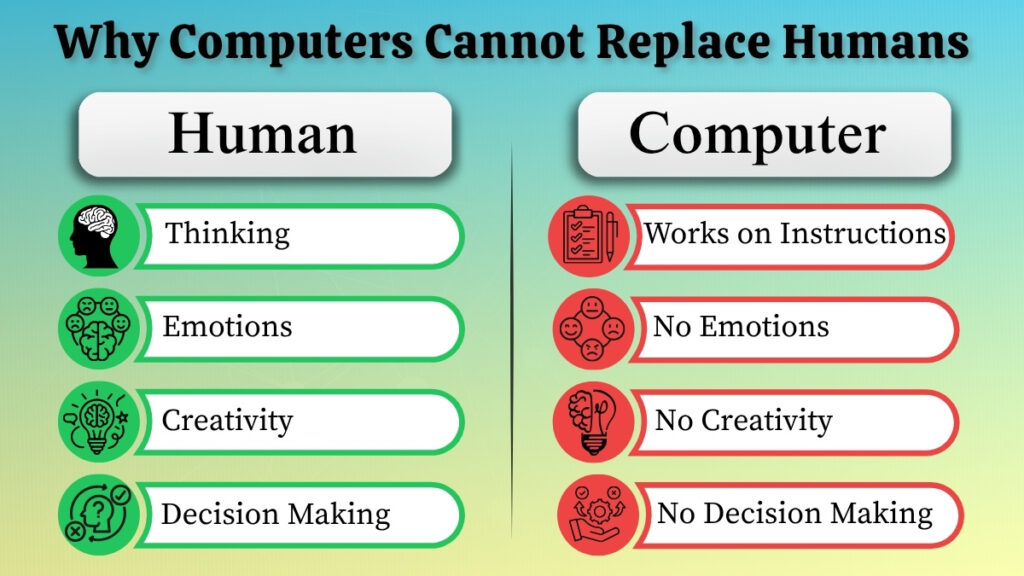
Humans have many abilities that computers don’t, such as intelligence, emotions, creativity, and the capability to make complex decisions. Humans can analyze situations, do judgement, and respond in the required manner flexibly.
On the other hand computers only follow instructions and logical rules. They cannot understand emotions, values, or real life situations in the same way humans do.
Because of these differences and inabilities, computers cannot replace humans. In fact, they act as a supportive tool to make human life easier and faster.
Importance of Understanding Computer Limitations
Understanding computer limitations is very important for beginners, in order to set realistic expectations.
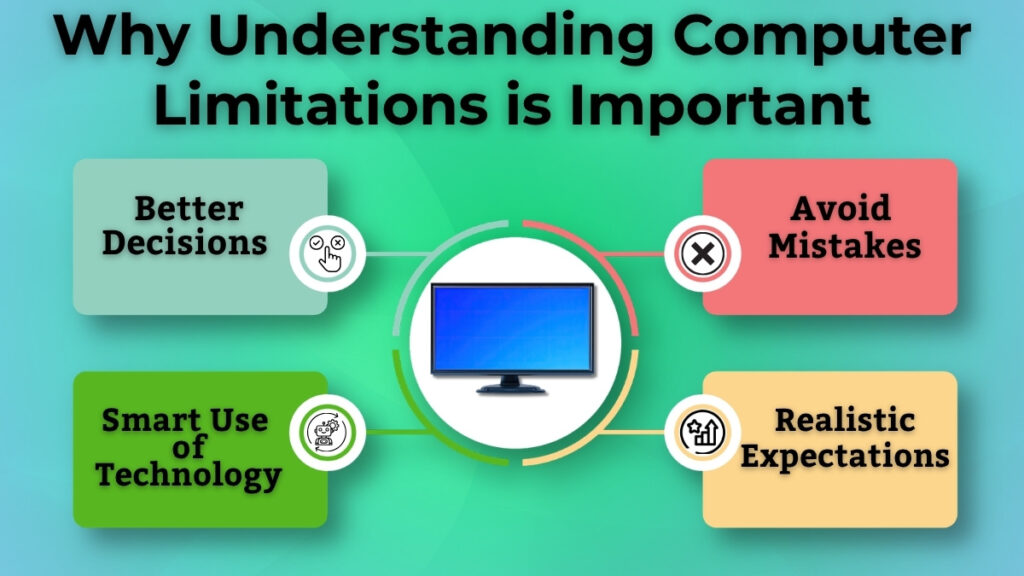
If the users misunderstand that computers are able to think or make decisions independently, they may misuse it or get too much dependent on them. Learning the limitations will help them in using computers wisely and effectively.
Awareness of these limitations will help:
- To avoid over-dependency on computers
- To use systems more responsibly
- To identify errors more easily
- To protect important data
- To improve overall computer usage
The clarity of limitations of computers will make computer usage more practical and efficient for users.
Conclusion
Every powerful tool or machine has certain limitations and computers are no exception. They are efficient machines but still not perfect. They have several limitations such as lack of emotional intelligence, dependency on instructions, absence of decision making ability, need for regular maintenance.
They also need continuous electricity power, and they need to be handled carefully to function smoothly.
If a beginner understands these limitations, they will be able to develop a realistic and balanced view of computer usage. It will prevent over dependency and encourage responsible usage of technology.
When humans and computers work together, best results are achieved. Also when human intelligence is combined with computer efficiency, it creates a highly effective and productive system.