
Advantages and Disadvantages of Computers
Introduction
In today’s modern world, computers have become an essential part of daily human life. In almost every sector, from schools and offices to hospitals, entertainment, and even homes, computers are useful everywhere. They are widely used for making many daily tasks easier, faster, and much more efficient.
However, just like every coin has two sides, every technology also has its limitations and challenges. Although computers offer us immense benefits, they still come with certain pros and cons.
The main purpose of this article is to explain the advantages and disadvantages of computers by understanding their strengths and weaknesses, so users can use technology in a smarter and more responsible way.
Advantages of Computers
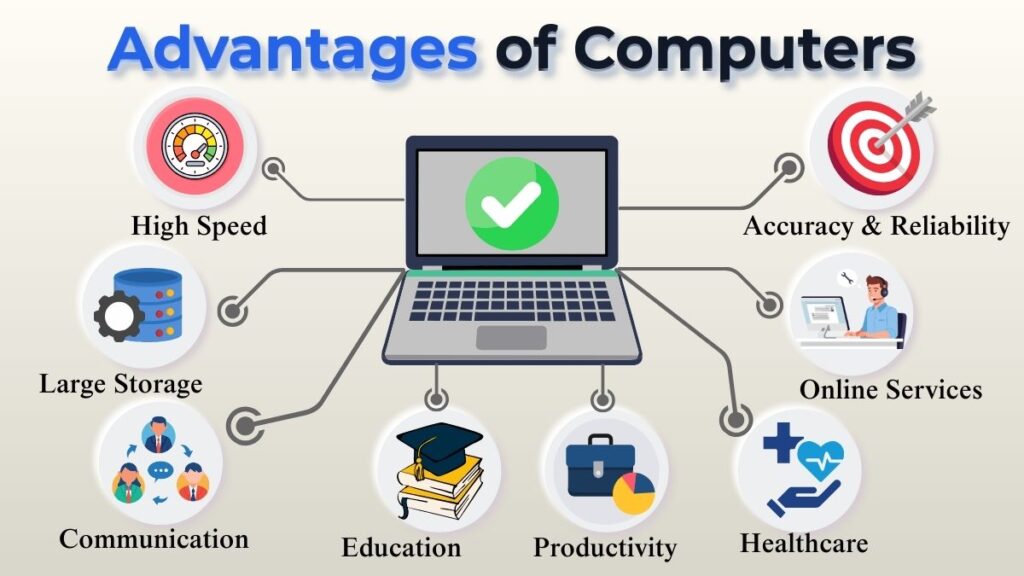
Computers have mainly changed the way humans work, learn, and communicate. Over the years, computers have evolved from being a large calculating machine to becoming a powerful tool that is capable of handling huge amounts of information.
- High Speed and Efficiency – One of the major advantages of computers is their speed and efficiency. Computers can easily process data and perform calculations within seconds, which would take hours or even days to complete manually. This speed of processing tasks helps humans by saving valuable time and effort. Some examples are report generation, data analysis, and online transactions. All this has become much faster with computers.
- Accuracy and Reliability – If the instructions are given correctly, then computers provide highly accurate results. They produce consistent results and reduce human errors. Computers are used in many fields like engineering, finance, and scientific research because accuracy is very important in these fields, and computers ensure that mistakes are reduced as far as possible. So, this reliability is the main reason why computers have become an essential part of these fields.
- Large Storage Capacity – Computers can store huge amounts of digital data, this is another major advantage. They can save thousands of documents, images, and multimedia files without taking any physical space, which is not possible for traditional methods of storing data. Also, the digitally stored data or information can be easily accessed quickly and efficiently at any time, making information more manageable and organized than ever.
- Role of Computers in Education – Computers have become a vital tool in today’s digital learning era. They help students in online learning by providing access to a variety of digital learning resources such as e-books, online classes, and interactive lessons. They also help students with the completion of assignments and research on topics. Nowadays, teachers also widely use computers for preparing lessons, evaluating performance, organizing data, and communicating effectively with students digitally.
- Improved Communication – Communication has become faster and easier with the help of computers and the internet. We have various ways, such as emails, video calls, messaging apps, and social media platforms, to connect with people across the world in real time. This has reduced distance barriers and improved global connectivity.
- Improved Productivity in Workplaces – Computers are used in offices, businesses, and workplaces for creating documents, managing data, maintaining records, sending emails, and performing calculations. Automation through computers helps organizations work more efficiently and accurately and also saves a lot of time and effort.
- Use of Computers in Healthcare – Computers are widely used in the healthcare sector. They are used for maintaining patient records, assisting in medical diagnosis, managing hospital systems, and operating advanced medical equipment. They improve the quality of healthcare services and help doctors to provide better treatment.
- Entertainment and Creativity – Various forms of entertainment that we enjoy, such as movies, music, games, and online content, are provided by computers. They also help people to express their creativity through graphic design, video editing, music production, and writing. Many modern careers have emerged because of computer-based creative fields.
- Supports Online Services – Services like online banking, digital payments, online shopping, and ticket booking are only possible because of computers. These services provide convenience to users, save time, and reduce paperwork. Computers have made it possible to access these services safely and efficiently from anywhere, which has enhanced our everyday life.
Disadvantages of Computers
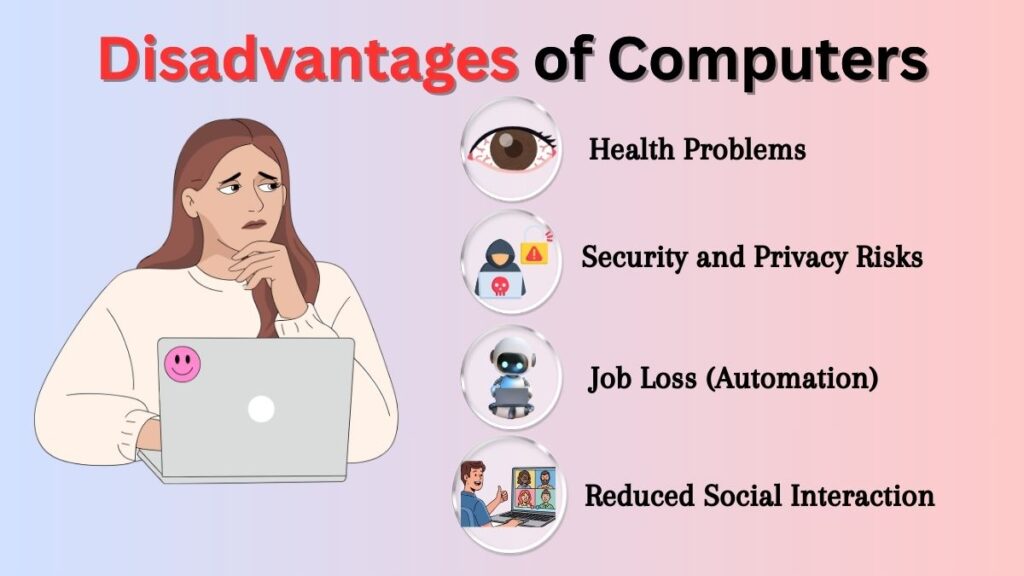
Although computers have many benefits, they still have some limitations that cannot be ignored. Understanding these limitations and drawbacks will help us with the responsible and safe usage of computers.
- Health Problems – Excessive use of computers can lead to certain health issues such as eye strain, headaches, back pain, and poor posture. Staying long hours in front of a screen can affect the sleep cycle and reduce physical activity. It is necessary to take breaks and follow physical activities like exercise and workouts to prevent such health issues.
- Addiction and Dependency – Nowadays, almost everyone, including children/students, professionals, employees, and freelancers, has become highly dependent on computers for their daily activities. Excessive use of computers, especially for gaming and social media, can lead to addiction, reduce productivity, affect mental health, and also disturb personal relationships.
- Job Displacement – Automation and computerization have replaced many manual jobs. The tasks that were earlier done by humans are now performed by machines and software. This has increased unemployment in some sectors, especially for low-skilled workers. The only way to stay relevant in the market is by upgrading one’s skill set.
- Security and Privacy Risks – Computers that are connected to the internet are vulnerable to cyber threats such as hacking, viruses, data theft, and online fraud. If proper security measures are not taken, then our data can be misused. Users should take precautions by using strong passwords, installing antivirus software, and using secure networks to protect personal data.
- High Cost and Maintenance – Despite the fact that computers are useful, they also require regular maintenance, software updates, and sometimes expensive repairs. Advanced hardware and software are costly, which makes them unaffordable for many people. In addition, repairs and technical support are needed, which adds to the overall expense.
- Lack of Human Intelligence – Computers cannot think critically, feel emotions, or make decisions on their own. They only work according to the instructions provided by users. Unlike humans, computers lack creativity, common sense, and critical thinking abilities. Thus, they cannot perform tasks independently.
- Environmental Impact – The production and disposal of computers contribute to electronic waste that can harm the environment. Discarded devices, batteries, and accessories can harm the environment if they are not recycled properly. Improper disposal of components releases dangerous chemicals into the soil and water. Awareness of e-waste management is very important to reduce this impact.
- Reduced Social Interaction – Excessive usage of computers and digital devices reduces face-to-face communication. Nowadays, it is common that people spend more time online and less time interacting with family and friends, which affects social relationships. Spending too much time online can weaken social bonds, reduce interpersonal skills, and affect real-life interaction. It is very important to create a balance between the usage of computers and personal social interactions.
Balanced Use of Computers
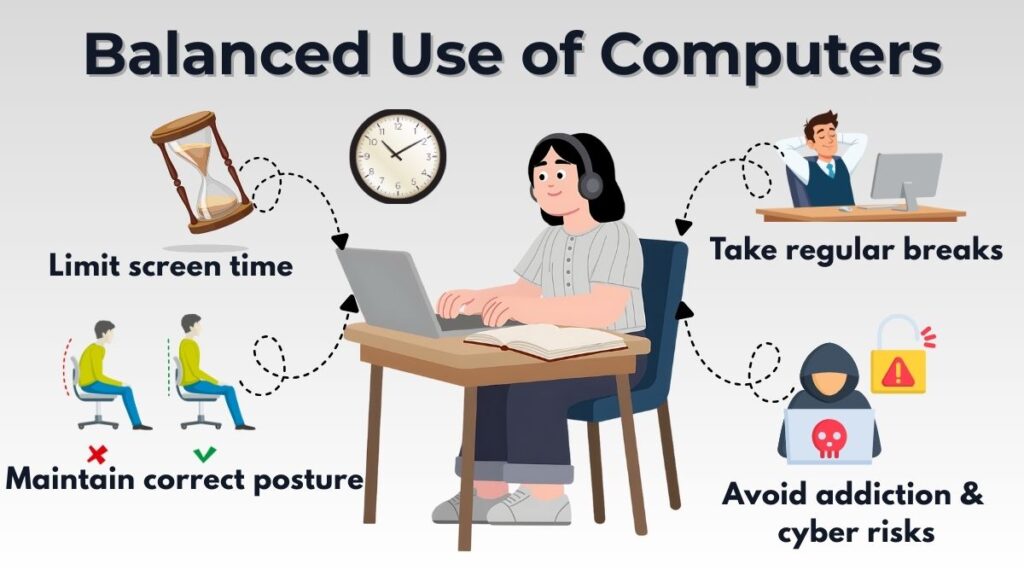
The only way to maximize the benefits of computers while minimizing their drawbacks is through balanced and responsible use. Some essential practices include:
- Limiting screen time.
- Taking regular breaks.
- Maintaining correct posture.
- Taking measures to avoid addiction and cyber risks.
Conclusion
Computers have transformed the way humans live, work, and communicate. They offer many advantages, such as reliability, speed, accuracy, storage, convenience, and efficiency. These capabilities are the reasons why computers have become an essential part of modern life, but on the other hand, computers also have some disadvantages, like health issues, dependency, security risks, and environmental concerns. Humans should use computers as supportive tools to enhance skills, productivity, and creativity, rather than completely depending on them.
By understanding both the advantages and disadvantages of computers, we can use them effectively and responsibly, instead of relying on them blindly. If computers are used wisely, then they can improve productivity, learning, and quality of life without creating negative impacts. Thus, computers are neither entirely good nor bad; the simple fact is that their impact depends on how humans use them.
Overall, computers are powerful tools whose impact depends entirely on how wisely and responsibly they are used.
Pingback: History and Evolution of Computers – 5 Generations Explained
Pingback: Analog vs Digital vs Hybrid Computers – Easy Guide
Pingback: Data, Information and Processing Explained | Comtechzone